Explore common pallet facts and misconceptions that have daily impact, such as the idea that hardwood pallets are better than softwood, or plastic pallets are superior to wooden ones.
Many supply chain problems begin with a misunderstanding. A pallet may appear to be the problem when the real issue is rooted in another part of the product’s packaging solution. A material may seem stronger because of its name. A standard pallet may seem sufficient until product damage, handling issues or rising costs reveal a different operational reality.
That is why accurate pallet facts matter. In procurement, manufacturing and logistics, pallet decisions should be based on application requirements rather than assumptions that have been repeated and reinforced over time.
Pallet Facts That Every Supply Chain Team Should Evaluate
Many pallet misconceptions are rooted in partial truths. A skid and a pallet look similar. Hardwood sounds like it should be stronger than softwood. Both plastic pallets and wood pallets have merit.
The key to debunking pallet misconceptions is that pallet performance depends on the application. Product characteristics, handling methods, storage conditions and transportation requirements all influence how a pallet performs throughout the supply chain.
Procurement, supply chain and manufacturing leaders need to understand that pallet performance depends on the application, not common assumptions.
Skid vs Pallet: Different Platforms, Different Applications
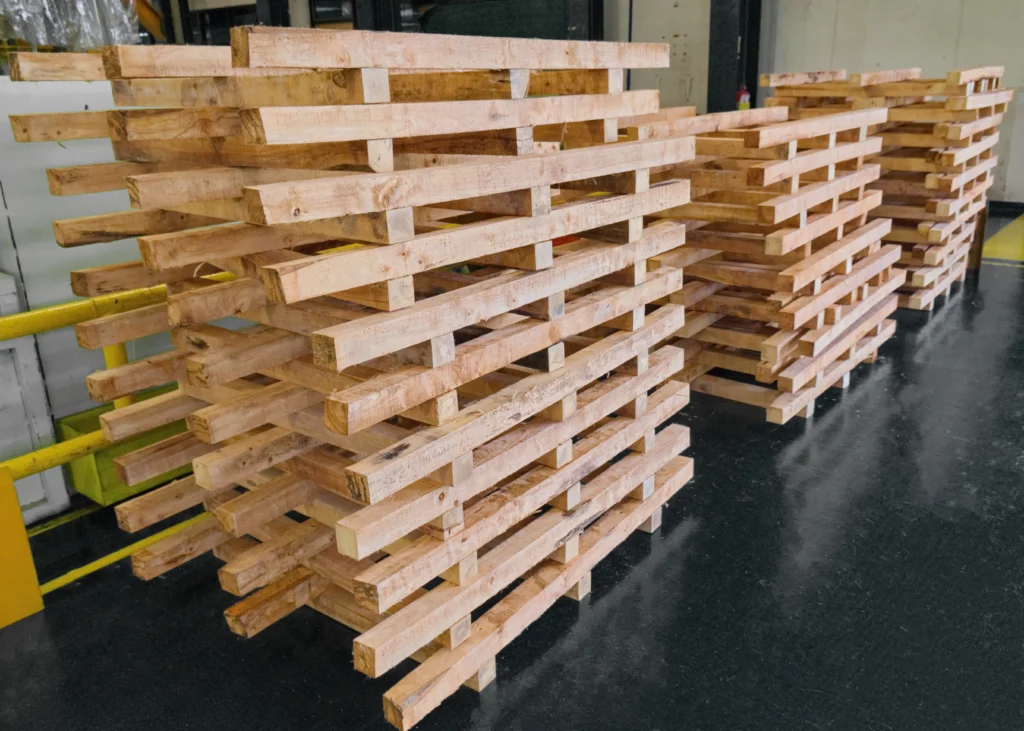
One of the most common misconceptions is that a skid and a pallet are interchangeable. In reality, there is a hugely important structural difference: A pallet typically includes both top and bottom deck boards, while a skid does not have bottom deck boards and instead rests on runners. That difference affects how each platform performs.
Pallets are generally better suited for repeated handling, transportation and movement throughout a supply chain because they provide greater stability, while skids are often used for stationary storage or heavy equipment applications.
The skid vs pallet distinction matters because appreciating how they function differently can influence purchasing decisions, saving a company from the frustrations of realizing that it bought skids when it needed pallets or vice versa.
Skid vs Pallet
Pallet: A material handling platform with both top and bottom deck boards designed primarily for transportation and repeated movement.
Skid: A platform that typically rests on runners without bottom deck boards and is often used for storage or stationary applications.
Hardwood vs Softwood Pallets: Material Names Do Not Tell the Whole Story
Many people assume that hardwood pallets are always stronger than softwood pallets. The misconception is understandable because hardwood sounds stronger than softwood. However, hardwood and softwood are actually ways that botanists (like The United States Department of Agriculture’s Forest Products Laboratory) classify woods, not inherent descriptions of their durability.
While the material does matter, pallet performance depends on much more: wood species, pallet construction, load requirements, handling methods and storage conditions all influence real-world performance and supply chain efficiency.
The question is not whether hardwood or softwood is universally stronger. The question is whether the pallet has been engineered for your application’s load, handling environment and performance requirements.
Plastic vs Wood Pallets: The Best Choice Depends on the Application

Plastic pallets offer advantages in environments where hygiene, washability or moisture resistance are critical. This can make them a strong fit for certain food, pharmaceutical and specialized manufacturing applications. However, plastic pallets are not automatically the best choice for every operation.
Wood pallets remain widely used because they are repairable, recyclable, readily available and cost effective across many supply chains. Wood is also a fundamental and sustainable resource component for moving goods, as it can often be reused, repaired and recovered at the end of its service life.
When evaluating plastic pallets vs wooden pallets, organizations should consider hygiene requirements, reuse expectations, handling methods, sustainability goals and total cost over time.
In other words: The best pallet material is the one that fits the application.
Quick Comparison: Common Assumptions vs Operational Reality
| Common Assumption | Operational Reality |
| “A skid and a pallet are the same thing.” | Different structures support different uses. Skids and pallets serve very different operational purposes. |
| “Hardwood pallets are always stronger.” | Design and application matter more than broad material categories. |
| “Plastic (or wood) pallets are always better.” | Each material offers advantages depending on the application. |
| “One pallet design works everywhere.” | Product, handling and storage requirements all influence pallet performance. |
Why One Pallet Design Does Not Fit Every Application
Perhaps the most costly pallet misconception is the belief that one design works for every application.
A pallet carrying lightweight consumer goods may face very different demands than a pallet supporting heavy industrial components. A pallet used in a traditional warehouse may require a different design than one moving through an automated system. A company should not use the same pallets to ship food internationally as they would use to ship roof shingles domestically.
Product size, weight, handling equipment, storage methods and transportation conditions all influence pallet performance.
This is where Millwood’s Packaging Science approach becomes valuable. Rather than evaluating the pallet alone, Packaging Science looks at the complete unit load, including the pallet, packaging materials, stretch wrap and handling environment. Understanding how these components work together helps to identify solutions that improve performance, reduce waste and support operational goals.
The fact is: the best pallet is the one designed for the application.
Looking Beyond Common Pallet Myths
Many pallet myths persist because they sound reasonable. The challenge is that assumptions do not always reflect operational reality.
A clearer evaluation that produces better results begins with better questions:
- What product is being shipped?
- How will it be handled?
- How will it be stored?
- Will it move through automation?
- Will it be reused?
These questions help move the conversation from assumption to application.
With that in mind, if you have a pallet question or common pallet myth you’d like us to address, contact the Millwood team directly. We’re always looking for opportunities to answer real-world pallet and packaging questions and to help you to find the right pallet for your specific application.
Whether you’re comparing hardwood vs softwood pallets, evaluating plastic pallets vs wooden pallets or simply looking for reliable pallet facts, Millwood helps customers to make informed decisions based on operational performance and supply chain needs. Learn how Packaging Science and operational analysis help determine the most effective configuration, pallet design and material for specific applications.