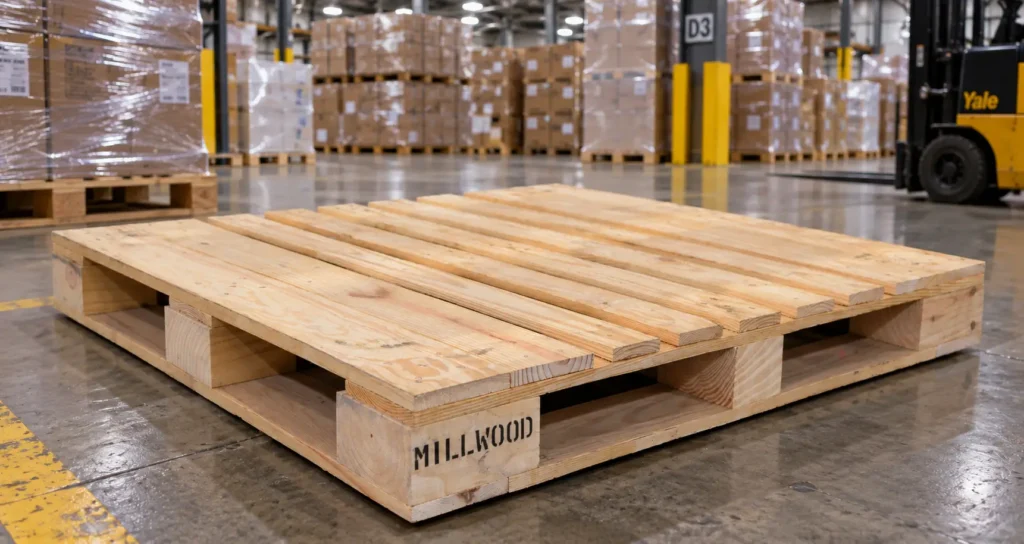

When customers purchase pallets, the conversation often starts with dimensions.
For instance, a buyer may request a 48×40 standard GMA pallet, compare quotes from multiple pallet suppliers and select the lowest price.
Problem solved, right?
At Millwood, we have seen firsthand how this approach actually creates operational headaches and waste for customers across industries.
That is because, while standard pallet sizes exist, pallet performance depends on far more than dimensions alone. Two pallets with the same footprint can perform very differently depending on their configuration, materials, handling requirements and intended use.
As Millwood President Chip Trebilcock explains after more than 40 years in the industry:
“Even if it’s a standard size, there’s no such thing as a standard pallet.”
While Millwood regularly works with customers who start the conversation with dimensions, we never stop there. Instead, we consider every angle required to engineer the best custom pallets for their needs – angles we will explore today.
Why Standard Size Does Not Mean Standard Performance
Many industries rely on common pallet footprints.
If you’ve operated in pallet procurement for even a day, you know the standards:
- 48×40 pallets
- 48×48 pallets
- 42×42 pallets
These dimensions help support many common product sizes and transportation requirements.
What they do not tell you is how the pallet is built, what material it’s made of or how long it’s supposed to last.
In other words, dimensions only answer one question:
How much space does the pallet occupy?
They do not answer questions about:
- Wood species
- Lumber thickness
- Deck board configuration
- Load capacity
- Handling requirements
- Reuse expectations
- Operational environment
A pallet designed for lightweight consumer goods may look similar to a pallet carrying heavy industrial equipment. While the general dimensions match, however, pallets that are supposed to carry oranges need to be different from pallets carrying turkeys or pallets carrying solar power equipment.
Companies that try to fit a square peg into a round hole in this way experience much more inefficiency and frustration than they need to.
So while it’s helpful to talk about standard sizes, that is what we mean when we say there is no such thing as a standard pallet. And that’s exactly how Millwood approaches pallet configuration: each pallet is engineered to match our customers’ unique applications.
What Actually Determines Pallet Performance?
Effective pallet design starts not with choosing dimensions but rather with understanding the customer’s application.
This application-first approach is one of the reasons Millwood views pallet design differently to many pallet suppliers. Rather than starting with a specification alone, our Team works to understand how our customers’ products move, how they are handled and what operational demands will be placed on the pallet throughout its lifecycle.
Rather than asking, “Which pallet size do we need?” we like to ask:
“What do these pallets need to do?”
Several factors influence pallet performance, as we discuss below:
1. Product Requirements
The product itself drives many considerations around custom pallets.
These include:
- Product weight
- Load distribution
- Packaging configuration
- Product fragility
- Stacking requirements
Shipping pistachios is very different from shipping aerospace components. Millwood keeps this distinction top of mind when designing custom pallets.
That’s why we work with customers to engineer the best custom pallets for their products, ensuring that their pallets fit their application instead of creating unwanted problems in the distribution chain.
2. Handling Environment
Handling environments are often just as important as product requirements.
That’s because many pallet issues originate not from the product but from the way the pallet moves through an operation.
Handling considerations include:
- Forklifts
- Pallet jacks
- Conveyor systems
- Automated equipment
- Warehouse storage systems
In many facilities, equipment requirements influence pallet design just as much as the load itself.
Millwood frequently encounters situations where pallet failures are initially attributed to pallet size or pallet quality. After evaluating the operation, customers can be surprised to learn that the root cause is tied to handling conditions, storage requirements or equipment interactions they did not consider during the original pallet selection process.
So, no matter the handling requirements, Millwood engineers custom pallets fit for the application.
3. Transportation and Storage Requirements
Transportation and storage conditions create additional performance demands.
Performance-related questions often include:
- Will the pallet be stored in racking?
- Will it travel long distances?
- Is it part of a one-way shipment?
- Will it be exposed to varying environmental conditions?
- Will it be stored inside or outside?
The answers to these questions influence how the pallet should be configured. When considering whether a pallet will experience extreme cold, heat or moisture, for instance, flexible transportation logistic solutions are often necessary.
Once more, it is worth emphasizing that pallets that only take into account dimensions perform poorly compared to custom pallets. When transportation and storage are not properly accounted for, pallet failure and product damage result.
4. Lifecycle Expectations
Not every pallet is designed with the same service life. Some customers want reusable pallets. Others want pallets that they can easily break down after transportation.
Some pallets are intended only to move products from Point A to Point B – one and done. Others are designed for multiple trips, repeated handling cycles and repairability.
Understanding lifecycle expectations helps determine the most cost-effective solution for the application.
Key Factors Affecting Pallet Performance
| Factor | Why It Matters |
| Product Weight | Influences load-bearing requirements |
| Load Distribution | Determines where stress occurs |
| Lumber Selection | Affects strength, durability and cost |
| Deck Configuration | Impacts support and load stability |
| Handling Equipment | Influences structural requirements |
| Storage Systems | Creates different support demands |
| Transportation Conditions | Introduces vibration, impact and compression forces |
| Reuse Expectations | Influences design and lifecycle planning |
Case Study #1: When a “Standard” Pallet Creates Expensive Problems
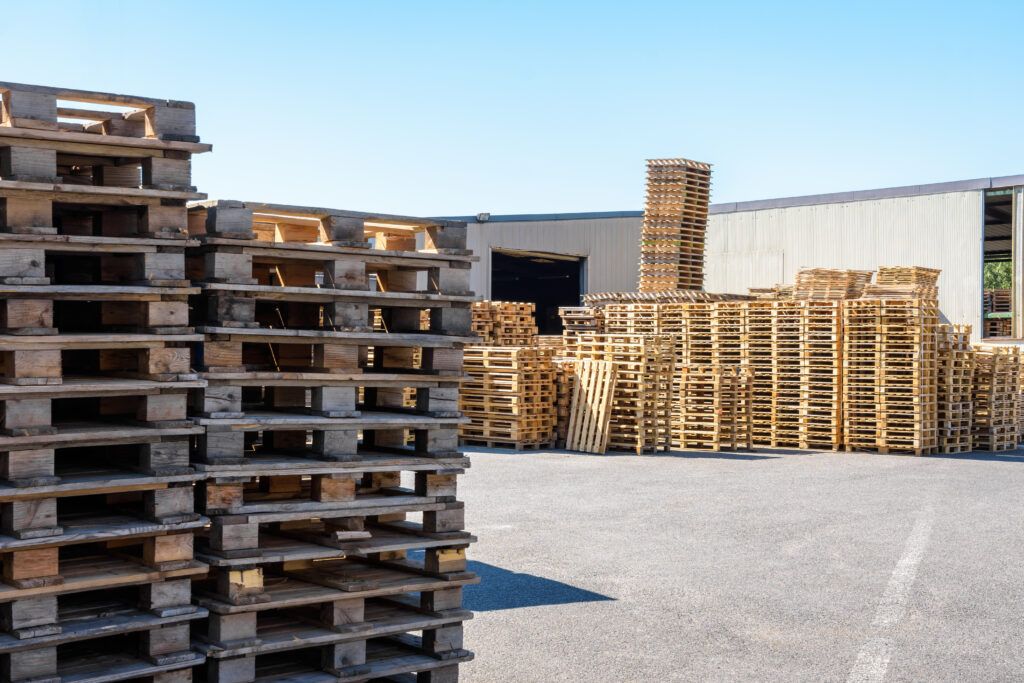
The consequences of treating pallets as interchangeable products can be significant and costly.
One manufacturer approached Millwood after experiencing extensive pallet failures throughout its operation.
The pallet dimensions appeared correct and fit the product, yet truckloads of broken pallets were being discarded every week.
The company was losing around $65,000 per month through pallet failures, disposal costs and operational inefficiencies.
After evaluating the application, Millwood discovered the issue.
The pallets were being constructed with materials inappropriate for the demands being placed on them. The lumber selection and overall pallet configuration were misaligned with the realities of the operation.
By partnering with Millwood to redesign the pallet around the application, the customer significantly reduced pallet failures and associated costs.
The lesson was simple: the problem was not the pallet size, but pallet design.
This case study also shows why there’s no such thing as a “standard pallet”: every operation requires custom pallets to flow the way it is supposed to.
Case Study #2: Sometimes the Best Solution Is Not a Different Pallet
Not every challenge requires a different pallet. In some cases, the opportunity to reduce waste and improve efficiency is found elsewhere.
Consider roofing manufacturers Millwood has served by evaluating how their products are stacked and shipped. After analyzing stacking patterns and trailer utilization, Millwood helped to redesign their load configurations around more common pallet footprints, improving trailer efficiency and reducing overall costs.
In other words, the pallet remained just one part of the solution. The larger goal was improving supply chain performance.
This illustrates another important principle that Millwood abides by:
Packaging decisions should be evaluated in the context of the entire unit load system rather than individual components.
How Packaging Science Changes the Conversation
What Is Packaging Science?
Packaging Science is the process of evaluating how pallets, packaging materials, stretch film and products perform together as a complete unit load moving through the supply chain.
Where traditional pallet purchasing often focuses on dimensions and price, Packaging Science takes a broader view.
Rather than examining the pallet in isolation, Packaging Science considers:
- The pallet
- The product
- Stretch film
- Packaging materials
- Load stability
- Transportation conditions
- Handling environments
The objective is not simply to create the best custom pallets but to improve the entire transportation system.
Through Packaging Science evaluations and testing performed in the ISTA-certified Millwood Lab, the Team often finds that pallet-related problems are not necessarily pallet problems.
In many cases, load configuration, packaging materials, stretch film performance and handling practices contribute just as much to the outcome as the pallet itself.
This empirical perspective helps customers to avoid solving the wrong problem and investing resources inefficiently.
Instead, through testing and analysis, the Millwood Lab helps validate how pallet and packaging decisions affect real-world performance.
This approach helps customers to reduce product damage, improve handling efficiency and support long-term supply chain reliability.
Why Custom Pallets Focus On Configuration, Not Size

What Are Custom Pallets?
Custom pallets are pallets engineered around a specific application. While some custom pallets use non-standard dimensions, many use common footprints with customized materials, deck layouts or structural features designed to support unique operational requirements.
When many people hear the phrase “custom pallet,” they imagine unusual dimensions.
Sometimes that is true. However, many custom pallets use common industry footprints. For instance, custom pallets can come in the form of a 48×40, not just a 60×10.
A custom pallet may include:
- Different lumber selections
- Alternative deck configurations
- Additional load support
- Specific entry requirements
- Features designed for automated systems
- Enhanced durability for multi-trip use.
In other words, a pallet can be a standard size and still involve a custom configuration.
This is why Millwood focuses on understanding the application first.
Choosing a Pallet Supplier That Understands Your Operation
Pallet purchasing is often viewed as a procurement decision: look for the specs, find the cheapest price.
In reality, it is also a performance decision.
After supplying, repairing and analyzing literally billions of pallets over the past four decades, across a wide range of industries, Millwood has seen consistently how application requirements influence pallet performance.
That experience reinforces the thesis of this article: dimensions alone rarely tell the whole story.
The right pallet supplier helps evaluate:
- Operational requirements
- Handling environments
- Unit load performance
- Material selection
- Cost drivers
- Long-term reliability
This consultative, scientific approach has helped customers avoid both under-engineering and over-engineering, ensuring the solutions they receive align precisely with the realities of their operation.
There Are Standard Sizes. There Is No Standard Pallet.
Standard pallet footprints exist. Common pallet styles exist. Industry conventions exist.
But, for all the reasons we have discussed, pallet selection should be viewed as a supply chain performance decision rather than a commodity purchasing decision.
The goal is not simply to buy a pallet. The goal is to identify the solution that best supports the application.
When pallet decisions are approached through operational analysis, Packaging Science and unit load optimization, customers can improve performance, reduce waste and make better supply chain decisions.
Custom pallets make all the difference.
Start the Conversation
If you are evaluating your operation’s pallet performance, experiencing pallet-related inefficiencies or looking for pallet solutions designed around your application, our Team is ready to serve you.
Connect with us to discuss pallet solutions designed around your handling environment, unit load requirements and long-term performance goals.
You can also learn how Packaging Science and the Millwood Lab help improve pallet performance, handling efficiency and long-term supply chain reliability.