
New or Recycled? Matching Pallet Selection to Your Operation
Deciding between new and recycled pallets? Learn how to evaluate cost, performance, and risk to connect pallet selection with your operation.
Refreshed May 14, 2026
8 Minute Read
Table of Contents

Josh Stipanovich
Josh serves as Communications Manager at Millwood, overseeing internal and external communications to ensure the company’s mission and message are delivered clearly and consistently. He leads initiatives ranging from company-wide communications and website content to PR, trade show promotions, and sales support materials. Since joining Millwood in 2014, he has played a key role in major projects including the company rebrand, website redevelopment, and HubSpot launch.
Stay Up To Date
Click the button below to recieve a collection of the latest case studies, articles and resources in Millwood’s newsletter in your inbox each month.
“The goal isn’t to choose between new or recycled. The goal is to make the right pallet selection for your load, your process and your risk tolerance.”
“At Millwood, we don’t begin with a product recommendation. We start by building a clear understanding of your operation: how your product moves, where challenges show up, and what your team is responsible for managing every day.”
Table of Contents
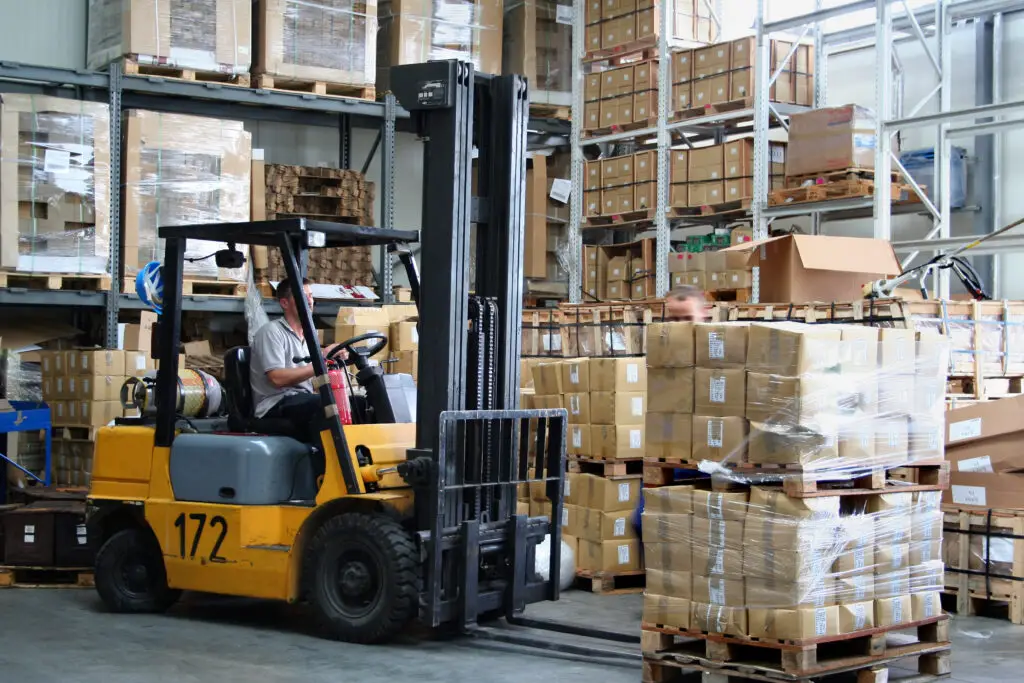
When evaluating pallets for your operation, it’s easy to frame the decision as a simple comparison: new vs recycled.
In practice, that framing often leads to the wrong decision.
The better question is:
What type of pallet will perform best in your specific supply chain – and how does that impact your overall pallet selection?
At Millwood, we regularly work with companies that are either overspending on pallets they don’t need or dealing with product damage and inefficiencies because their pallets aren’t built for their application. In both cases, the issue isn’t whether the pallet is new or recycled. It’s that the pallet isn’t the right fit.
It’s Not About New vs Recycled. It’s About the Right Fit.
Many pallet decisions are made based on habit or price.
Typically, a company has always used a certain pallet or they go out for bid and choose the lowest cost option that matches an existing spec.
But that spec isn’t always right – and it often leads to poor pallet selection decisions.
As Jim Pepperney, Western Sales Director at Millwood, explains:
“The customer will drive the spec… but the question is, do they fully understand what their operation actually requires?”
That gap is where problems show up:
- Some pallets are overbuilt, leading to a higher priced pallet they don’t need.
- Others are underbuilt, leading to product damage, instability and repeated failure.
The goal isn’t to choose between new or recycled. The goal is to make the right pallet selection for your load, your process and your risk tolerance.
If you’re evaluating options, it helps to start with a clear understanding of how recycled pallet solutions fit into your overall supply chain strategy.
What Really Impacts Pallet Performance in Your Operation
Before comparing pallet types, it’s important to understand what actually drives performance and, ultimately, influences pallet selection.
Load Requirements
Weight, distribution and stacking all affect how a pallet performs. A pallet that works in one application may fail in another.
Handling and Transportation
Forklift use, conveyor systems, racking and shipping conditions all impact durability over time.
End-User Expectations
In many cases, your customer determines what pallet you can use.
Jim Pepperney frames this expectation clearly:
“What does your customer demand of you? Some customers won’t receive anything unless it’s on a specific grade of pallet.”
Consistency Requirements
Automation systems and high-volume operations require uniform dimensions and predictable performance.
Environment and Industry Standards
Food, pharmaceutical and export environments may require higher levels of cleanliness, traceability or compliance.
When these factors aren’t fully understood, companies often default to a pallet type that doesn’t actually support their operation, leading to poor pallet selection outcomes.

Choosing the right pallet means aligning pallet selection strategy with operational requirements, performance expectations and long-term supply chain goals.
When New Pallets Make the Most Sense
New pallets are typically the right fit when consistency and control are the priority.
They are commonly used in situations where:
- Strict hygiene or regulatory requirements exist
- Custom sizes or engineered designs are required
- Automation systems depend on uniformity
- The cost of product damage is high.
Because new pallets are built from fresh material, they eliminate uncertainty related to prior use. That consistency can reduce risk in operations where variation leads to problems.
However, that performance comes at a higher upfront cost, which is why new pallets are not always the most efficient choice across an entire operation.
When Recycled Pallets Are the Right Fit
Recycled pallets are widely used in high-volume, standardized environments, which position them as an effective option for certain pallet selection considerations.
They are often a strong fit when:
- The operation uses standard 48×40 GMA pallets
- Cost efficiency is a primary driver
- Minor variation does not impact performance
- Pallets are used for shipping, storage or one-way movement.
Recycled pallets can perform reliably when they are properly sorted, repaired and graded.
Their real challenge is consistency.
As Millwood’s Team regularly sees, many buyers believe they are purchasing a specific grade, but there can be confusion around what that actually means in practice. Understanding grading and working with a supplier that applies it consistently is critical to performance.
If you’re not familiar with how pallet grades impact performance, it may be worth reviewing how grading works in more detail through our comprehensive guide to pallet grading.
Why Many Operations Use a Combination of Both
In most operations, the decision is not new vs recycled pallets – it’s both.
New pallets may be used where performance matters most, while recycled pallets are used where cost efficiency makes more sense.
This allows companies to balance cost and risk across different parts of their operation and refine pallet selection over time.
As Kyle Countryman, Millwood’s Eastern Sales Director, explains:
“It’s not as often as you think that someone is going from new to recycled or vice versa. Most of the time, it’s about adjusting within what they’re already doing.”
In other words, the focus is not on switching – it’s on optimizing your pallet selection strategy.
The Hidden Costs Most Buyers Overlook
One of the biggest mistakes in pallet purchasing is focusing only on price: while the upfront cost is easy to compare, the downstream impact is not.
Product Damage
If a pallet fails, the cost is not just the pallet. It’s the product, the claim and the disruption.
Inconsistent Performance
Variation in pallet quality can slow down operations and create inefficiencies, especially in automated environments.
Missed Deliveries and Downtime
This is one of the most overlooked risks.
As Jim Pepperney describes it:
“When pallets don’t show up, production stops. The facility can literally be hours from shutting down, and that buyer is accountable for it.”
That level of risk changes how pallet selection decisions are made.
Operational Pressure
In many organizations, the person responsible for purchasing pallets is measured on total cost savings – but also on keeping operations running.
When a pallet provider fails, the operational impact is immediate.
That’s why many companies are increasingly prioritizing reliability and service over small differences in price.
Real-World Example: Lowering Total Cost Without Increasing Risk
These hidden costs aren’t conjecture. Millwood has seen firsthand how pallet and packaging performances translate to real operational costs for customers.
In one engagement, a customer faced recurring product damage issues caused by design flaws in their existing transport packaging. Millwood used ISTA-certified stability testing to evaluate alternative options for their vertically shipped products. We settled on a solution that maintained load stability and reduced product damage, generating approximately $184,000 in annual savings across eight manufacturing facilities.
Customer stories like these strengthen the rationale that pallet decisions should be based on total operational performance, not just upfront price.
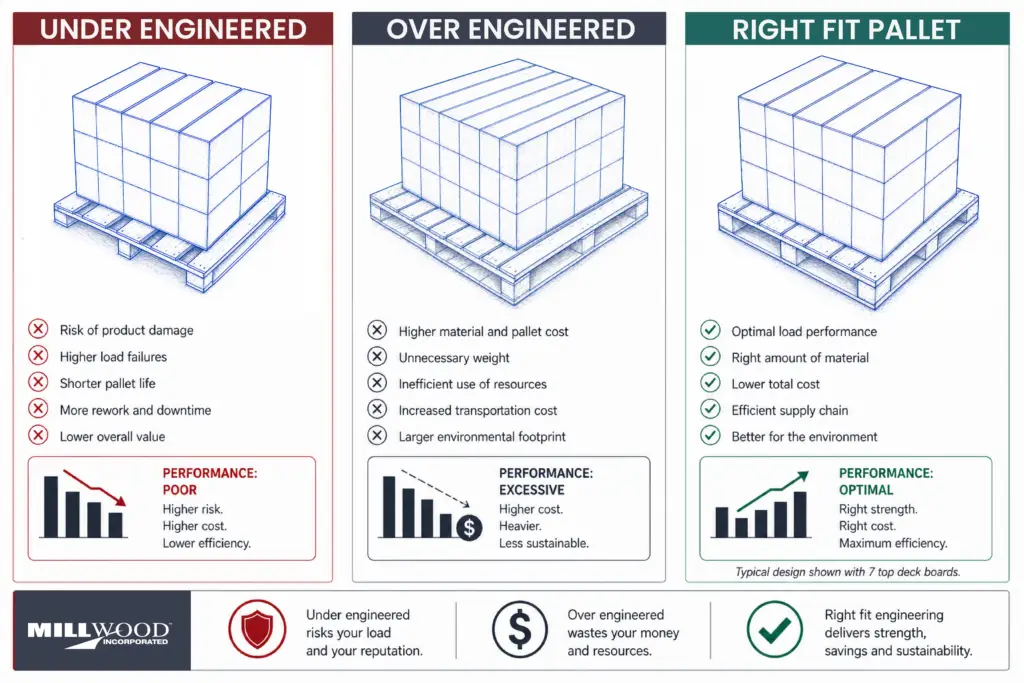
Optimal pallet selection balances cost, pallet performance and operational risk to avoid product damage, downtime and unnecessary material expense.
“The goal isn’t to choose between new or recycled. The goal is to make the right pallet selection for your load, your process and your risk tolerance.”
How to Determine the Right Pallet for Your Operation
Choosing the right pallet starts with understanding how your operation actually works.
At Millwood, we don’t begin with a product recommendation. We start by building a clear understanding of your operation: how your product moves, where challenges show up, and what your team is responsible for managing every day.
That clarity is what leads to better decisions – and better pallet selection.
Our approach is built around the Millwood SURE Process, which provides a consistent way to evaluate, refine, and validate the right solution.
Study
We take the time to understand your operation, including product flow, handling and any challenges that may not be obvious at first glance. This ensures decisions are based on what’s actually happening – not assumptions.
Understand and Engineer
From there, we work through what your operation truly requires. In some cases, that means refining an existing specification. In others, it may mean adjusting materials, design or pallet grade to better match performance needs.
Review and Verify
Before moving forward at scale, we confirm the solution performs as expected. That can include testing, field validation and adjustments to ensure it holds up in real conditions.
Expand
Once the right approach is in place, it can be applied across facilities or product lines to create consistency and long-term efficiency.
At Millwood, the SURE approach is grounded in real-world experience. Each year, our teams sort more than 80 million used pallets, repair over 50 million, and supply more than 23 million new pallets to customers across the country. That scale gives us a clear view into how different pallet types perform in actual operations – not just in theory, but across thousands of real-world applications.
This is how we know that confidence in your pallet selection – and the conversation behind it – matters.
As Kyle Countryman, Eastern Sales Director at Millwood, puts it:
“Our goal is to help people make the best decision. That’s why we want to have a real conversation about what’s actually going on in their operation.”
Because until your operation is clearly understood, it’s difficult to know whether new pallets, recycled pallets or a combination of both is the right fit.
New vs Recycled Pallets: Start with the Right Conversation
If you’re evaluating pallet options, the most valuable step is to look at how your current pallet selection is performing.
Are you seeing:
- Product damage in transit
- Inconsistent pallet quality
- Missed deliveries or supply issues
- Costs that don’t match expectations?
If you’re noticing any of these issues, the answer may not be switching pallet types, but instead improving your pallet selection strategy.
To explore your options or better understand how your current pallets are performing, connect with a Millwood Team Member to evaluate your pallet program and identify the solution that best supports your operation.
“At Millwood, we don’t begin with a product recommendation. We start by building a clear understanding of your operation: how your product moves, where challenges show up, and what your team is responsible for managing every day.”
Share:

FIND THE RIGHT PALLET FOR YOUR OPERATION
Millwood is more than a pallet supplier — we help businesses reduce product damage, avoid downtime and improve operational performance through smarter pallet selection strategies. Whether your operation requires new pallets, recycled pallets or a combination of both, our team works with you to evaluate risk, performance and total cost to identify the right-fit solution for your supply chain.
Related Articles
Josh Stipanovich
Josh serves as Communications Manager at Millwood, overseeing internal and external communications to ensure the company’s mission and message are delivered clearly and consistently. He leads initiatives ranging from company-wide communications and website content to PR, trade show promotions, and sales support materials. Since joining Millwood in 2014, he has played a key role in major projects including the company rebrand, website redevelopment, and HubSpot launch.
Stay Up To Date
Click the button below to recieve a collection of the latest case studies, articles and resources in Millwood’s newsletter in your inbox each month.