

Right Fit Pallets: A Packaging Science Approach
Learn how packaging science and right fit pallet design help reduce damage, improve efficiency and support long-term supply chain performance.
April 28, 2026
6 Minute Read
Table of Contents

Josh Stipanovich
Josh serves as Communications Manager at Millwood, overseeing internal and external communications to ensure the company’s mission and message are delivered clearly and consistently. He leads initiatives ranging from company-wide communications and website content to PR, trade show promotions, and sales support materials. Since joining Millwood in 2014, he has played a key role in major projects including the company rebrand, website redevelopment, and HubSpot launch.
Stay Up To Date
Click the button below to recieve a collection of the latest case studies, articles and resources in Millwood’s newsletter in your inbox each month.
“We do not see pallets as commodities. We see them as part of a system that needs to perform reliably, day after day. The goal is not the strongest pallet possible. The goal is the right pallet for your product, your process and your supply chain.”
“For many operations, only a handful of loads require heavy-duty performance. Applying the same design across every application can create cost and complexity without adding value.”
Table of Contents
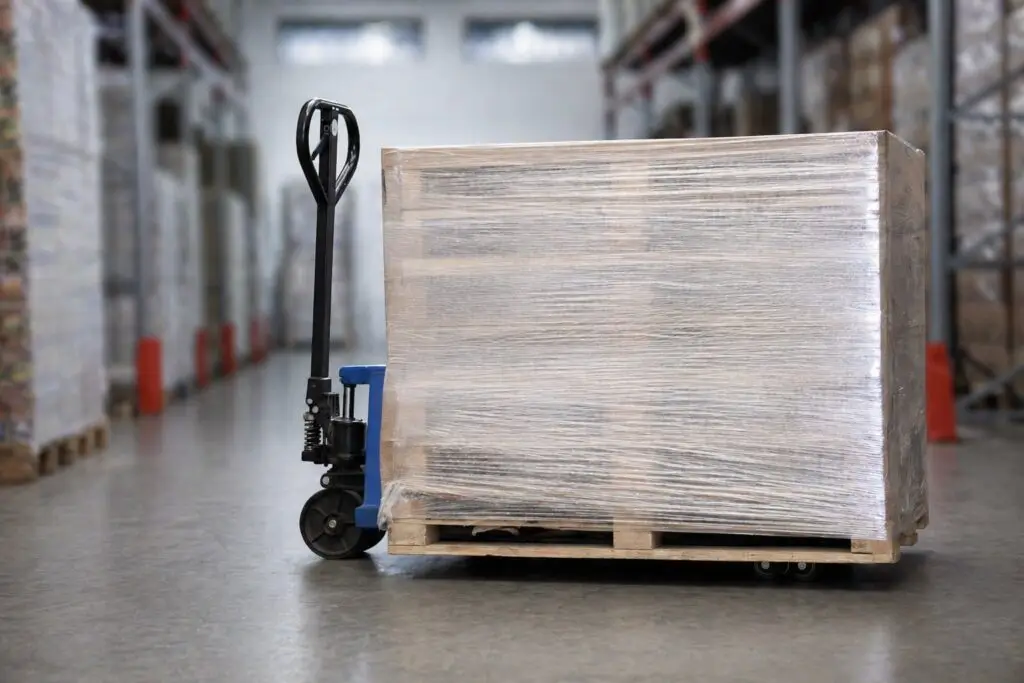
A unit load in motion shows how pallet, product and load securement must perform together in real handling conditions.
In real world operations, pallet decisions rarely fail all at once. More often, they fail quietly. Product damage increases. Loads become unstable. Extra stretch wrap or labor gets added just to keep things moving. Over time, those workarounds become routine and the root issue remains.
In many cases, the challenge is not workmanship or intent. It is a pallet that is either under-engineered or over-engineered for the application.
At Millwood, we approach pallet decisions the same way we approach packaging as a whole. We do not see pallets as commodities. We see them as part of a system that needs to perform reliably, day after day. The goal is not the strongest pallet possible. The goal is the right pallet for your product, your process and your supply chain.
Not too much. Not too little. Just right.
Why Pallet Selection is Really a Packaging Science Question
A pallet does not operate on its own. It is one part of a unit load system that must perform together in real conditions, including:
- the product it supports;
- how the load is built and secured;
- pallets, corner protectors, stretch wrap, shrink wrap and other load securement components;
- forklifts, conveyors and pallet jacks; and
- warehouse racking, floor storage, trailers, containers and daily handling realities.
When these elements are selected independently, problems often appear downstream. Loads shift during transport. Pallets that look fine at first struggle after repeated handling. Additional wrap or protection is added to compensate. Freight space is not used as efficiently as it could be.
Packaging science looks at the full system, not individual components in isolation. One advantage of working with Millwood is the ability to look at the entire unit load together. Through the Millwood Lab, we can evaluate pallets, load securement and protective components as a system to help determine what is truly needed and what is not.
For many teams, this is the point where it helps to step back and look at the unit load as a whole. If you are working through recurring pallet or load performance issues, Millwood’s Packaging Science team is always available to listen, ask the right questions and help you think through what a right fit approach could look like for your operation.
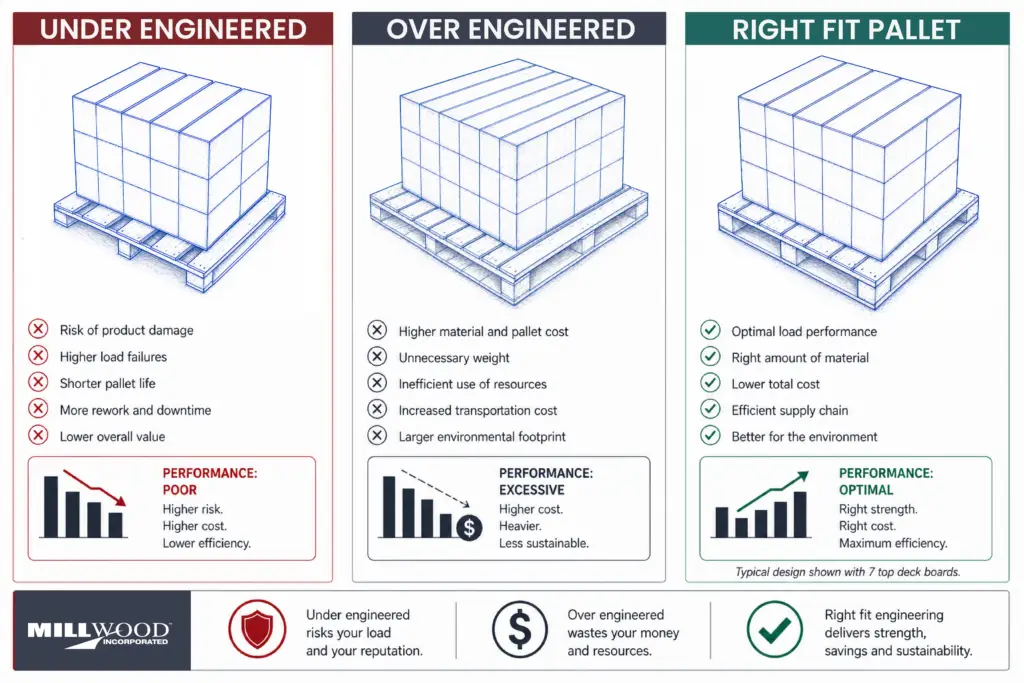
Right fit pallets balance performance and material use while under-engineered and over-engineered designs introduce risk or unnecessary cost.
The Risk of ‘Too Little’ When Pallets are Under-Engineered
Under-engineered pallets often appear acceptable at first glance. The issues show up when real conditions are introduced, including vibration, repeated handling, stacking and time.
We commonly see this when pallet design is based only on static load assumptions – when older designs are reused without accounting for changes in product or handling, or when material reduction happens without performance validation.
The results are familiar. Product damage increases. Loads require rework at shipping or receiving. Customer confidence is strained. Costs that were never planned for begin to grow.
In many cases, Teams try to compensate for under-engineered pallets by using more stretch film to stabilize the load before shipping. This adds material cost and time, yet still fails to properly protect the unit load, leading to continued damage and even higher long-term expenses from wasted film and compromised products.
In a recent example, we helped a leading manufacturer facing recurring damage avoid this mistake by reworking their pallet program through engineering analysis and testing. The result was not simply a stronger pallet. It was a right fit solution that delivered meaningful annual savings and reduced wood waste without compromising load performance.
The takeaway was simple. “More pallets” was not the answer. The right pallet was.
“For many operations, only a handful of loads require heavy-duty performance. Applying the same design across every application can create cost and complexity without adding value.”
The Hidden Cost of ‘Too Much’ When Pallets are Over-Engineered
Over-engineering often starts with a reaction. A pallet fails. Product is damaged. Expectations rise quickly, and the safest response can feel like building everything heavier to prevent it from happening again.
That response is understandable. We see it often.
But strength without context can introduce new challenges. Over-engineered pallets may include excess lumber, added weight and higher cost without improving performance. Freight costs can increase. Sustainability goals become harder to achieve. Material efficiency declines.
For many operations, only a handful of loads require heavy duty performance. Applying the same design across every application can create cost and complexity without adding value.
Right fit design is not about doing less or doing more. It is about doing what fits the job.
What ‘Right Fit’ Means in Practice
Right fit pallets balance real world factors, including:
- load weight and distribution,
- handling method and frequency,
- storage environment,
- transportation mode and
- expected lifecycle (such as one-way, multi-trip or closed loop use).
Together, these inputs drive pallet performance that holds up across the full journey – from production floor to final delivery – rather than only under ideal or static conditions.
In other words, from a packaging science perspective, ‘right fit’ means aligning design inputs with actual operating conditions, rather than assumptions.
Practically, this may require adjusting pallet dimensions to reduce overhang, modifying deckboard spacing to improve load support, designing for repeated handling instead of single moves or optimizing pallet size to make better use of trailer or container space.
These changes are not theoretical. They show up as fewer disruptions, smoother operations and more predictable performance.
The 48x40 Pallet: What is Standard and What is not?
The 48 by 40 pallet has long featured in North American supply chains. Its standardized footprint has helped improve compatibility across warehouses, carriers and handling equipment.
One of the most common questions we hear is whether a 48×40 pallet is always the right choice. In many cases, it is – but not automatically.
Another frequent question is: why do pallets with the same footprint perform so differently? While the footprint may be standard, performance is not, unless grading repair and verification are consistent.
Customers also ask how much pallet quality they truly need. Not every load requires the same level of performance. Over specifying or under specifying can both introduce unnecessary cost and risk.
This is where clear grading and verification matter. Matching pallet quality to the application helps reduce variability and supports more consistent outcomes. When standard pallets are applied thoughtfully, they perform very well. When conditions change, design and testing become more important.

Standard footprints like 48×40 can perform differently depending on design quality grading and real world conditions.
How Millwood Applies Packaging Science through the SURE Framework
Millwood approaches pallet and packaging solutions through our SURE Framework, a process designed to support long-term relationships and practical outcomes.
STUDY
We begin by listening. We take time to learn your goals, your challenges and how your product actually moves through production storage handling and transportation.
Understand
We engineer pallet and unit load solutions by evaluating real operating conditions, load requirements and performance expectations. This step turns what we learn into practical design direction.
REVIEW
Through the International Safe Transit Association (ISTA)-certified Millwood Lab, designs are reviewed, tested and verified under conditions that reflect real world handling. This step helps confirm performance and reduce uncertainty before broader deployment.
Industry-standard transport testing approaches help evaluate how unit loads perform under real world handling and transportation conditions. Organizations such as the ISTA have helped establish common testing frameworks used across the packaging industry, providing a shared foundation for evaluating performance without relying on assumptions alone.
EXPAND
Once a solution is verified, it can be scaled with confidence across locations, volumes and programs, creating long-term, measurable value.
This approach helps ensure pallet programs are built on evidence, not guesswork, and are designed to serve operations effectively over time.
Sustainability as an Outcome of Good Design
Right fit pallets naturally support sustainability goals. Using the appropriate amount of material, reducing product damage, minimizing the use of stretch film, extending pallet life and improving reuse and recycling outcomes all follow from thoughtful design.
Sustainability in this context is not a separate initiative. It is the result of doing things well.
A Better Way Forward
Choosing the right pallet is not about chasing the lowest price or the highest strength rating. It is about pallet optimization in the truest sense: matching design, material and performance to what the application actually requires.
At Millwood, packaging science helps customers move beyond trial and error toward solutions that scale reliably and support long-term goals.
Because when the pallet is just right, it does more than move the product – it helps move business forward.
“We do not see pallets as commodities. We see them as part of a system that needs to perform reliably, day after day. The goal is not the strongest pallet possible. The goal is the right pallet for your product, your process and your supply chain.”
Share:

EVALUATING YOUR PALLET PERFORMANCE?
Millwood’s Packaging Science team works with you to understand how pallets, load securement, handling systems and real-world conditions interact across your operation. Whether you’re addressing a specific issue or looking to improve performance at scale, we can help you evaluate your full unit load and identify data-driven opportunities for improvement.
Related Articles


Josh Stipanovich
Josh serves as Communications Manager at Millwood, overseeing internal and external communications to ensure the company’s mission and message are delivered clearly and consistently. He leads initiatives ranging from company-wide communications and website content to PR, trade show promotions, and sales support materials. Since joining Millwood in 2014, he has played a key role in major projects including the company rebrand, website redevelopment, and HubSpot launch.
Stay Up To Date
Click the button below to recieve a collection of the latest case studies, articles and resources in Millwood’s newsletter in your inbox each month.