
How to Prevent Pallet Mold

Flashback Friday: how to prevent pallet mold

This post was originally published in 2015. 
Interested in learning about industry topics from industry experts? The Millwood Blog is starting a guest author series doing just that! For the series debut, we invited Ralph Rupert, Manager – Unit Load Technologies, to discuss the lecture he gave at this year’s Western Pallet Association meeting.

Guest Author Series: Preventing Mold to Protect Wood Products

Mold is one of the leading technical issues for wood products. Visually it’s an eyesore, but even more importantly, mold is a health issue. With the role pallets play in transportation for food and pharmaceutical industries, there’s no disputing the need for mold-free pallets.

The key to preventing mold is to look at its origin – water. The spores that create mold are all around us, but without oxygen, a food source, and moisture, those spores can’t develop into mold. While chemical approaches can be effective for mold removal, the most practical way to prevent molding is by restricting moisture in the environment.

Tips for Controlling Your Moisture Content:

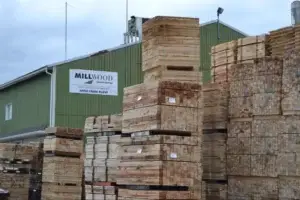
  1. Store pallets inside, where they can be kept dry. Leaving pallets out in the rain or humidity leave them at risk of mold growth.
  2. Similarly, unload pallets as quickly as possible. The less time spent in moist environments, the better.
  3. Use kiln or air dried lumber.
  4. Keep the storage area ventilated. Stagnant air prevents surface moisture on the pallets from evaporating. A little air movement goes a long way.
  5. Store pallets and lumber off the ground.
  6. Don’t store pallets on trailers—or as I like to call them, incubators. They’re humid, there’s little air movement, and the combination makes a perfect home for mold.
  7. Regularly take moisture content readings so you can be confident you are storing your pallets and lumber in a safe location

With proper care, mold can be avoided to preserve the integrity of pallets and wood products.

Author: Ralph Rupert

Share:

Join Our Newsletter

Related Articles

Millwood’s National Accounts Sourcing Manager Chad McConnell was named to the board of the Western Pallet Association (WPA), signifying Millwood’s active leadership and influence in advancing the pallet industry’s future.

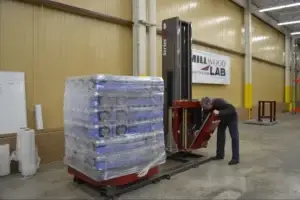
Millwood Lab technician inspecting a stretch wrapped unit load on a turntable stretch wrapper as part of end of line packaging maintenance for a customer.

Learn how total unit load maintenance keeps stretch wrappers, conveyors and other end of line packaging systems building stable, consistent loads.

Warehouse Team Members inside a trailer organizing wooden dunnage boards between palletized loads, demonstrating how careful arrangement is required to fill gaps, prevent lateral movement and protect products during transit.

Dunnage matters more than most people think. In fact, most people haven't even heard of dunnage. And yet, getting dunnage right can pay huge dividends for any operation shipping products nationally and internationally.

Stacked dimensional lumber in a Millwood industrial packaging facility showing the cross-sections of boards at various nominal lumber sizes, where the actual lumber dimensions after kiln drying and surfacing are visibly smaller than the nominal labels used to classify them.

If you've ever wondered about discrepancies in lumber sizes, you may be bumping into the issue of nominal vs actual lumber dimensions.

Download The Strategic Sourcing Report