Automated warehouses demand pallets with zero dimensional variance. A pallet that works in a manual facility can halt an automated line. Millwood engineers pallets as part of the full unit load system, validated through ISTA-certified testing, so automated operations run without interruption.
Every year, more warehouses and distribution centers adopt automated systems. Conveyors replace forklifts. Robotic arms stack loads. Automated storage and retrieval systems (ASRS) move product at speeds no manual crew can match.
Supply chain automation is no longer a future concept. It is the operating reality for a growing number of facilities across North America. As this shift takes place across industries, it is forcing many procurement officers and warehouse managers to consider: what does automation actually require from the pallets being used in our operation?
The answer is more than most expect. This is primarily because automated systems have zero tolerance for inconsistency. A pallet that performs well enough in a manual environment can create costly failures in an automated one. Understanding what changes and why is the first step toward making pallet decisions that protect uptime, reduce waste and support long-term operational goals.
What Supply Chain Automation Demands from Your Pallet Program
Supply Chain Automation
Refers to the use of technology (robotics, AI, conveyor systems, ASRS) to perform supply chain tasks that previously required manual labor. In a warehouse or distribution center, this includes robotic palletizers, automated guided vehicles (AGVs), conveyor systems and ASRS towers that store and retrieve products without human intervention.
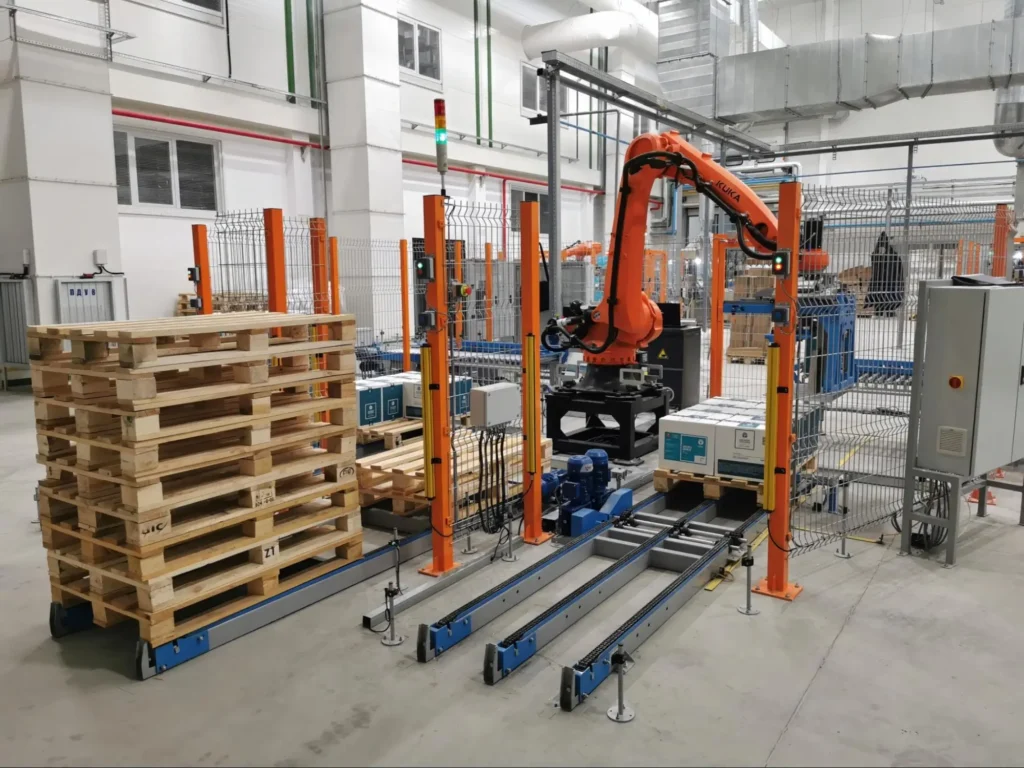
Here is what matters for your pallets: These systems are designed to exact specifications. They expect consistent dimensions, predictable weight distribution and reliable structural performance every single time. A two-inch variance in stack height or a warped deck board can halt an entire line.
Consider a global fast food leader that discovered a specification error weeks before launching a new automated distribution center that was equipped with an ASRS. A vendor supplied inaccurate product dimensions, miscalculating the stacked load by more than two inches.
In a manual warehouse, a Team Member with a forklift might adjust on the fly. In an ASRS environment, that variance threatened to delay a multimillion-dollar opening. Millwood’s Packaging Science Lab was used to redesign, test and validate three new pallet configurations under compressed timelines to keep that launch on schedule.
That story illustrates a principle Millwood’s engineering Team has observed consistently: automation does not just raise the bar on pallet quality. It eliminates the margin for error entirely.
The pallet is no longer a passive platform. It is a precision component of the system.
Automated Racking and the Tolerance Problem
Dimensional Tolerance
This is the allowable range of variation in a pallet’s physical dimensions (height, width, length, deck board spacing). In manual operations, tolerances are forgiving because a human operator can see and adjust. In automated racking, the machinery cannot adapt. It either works or it stops.
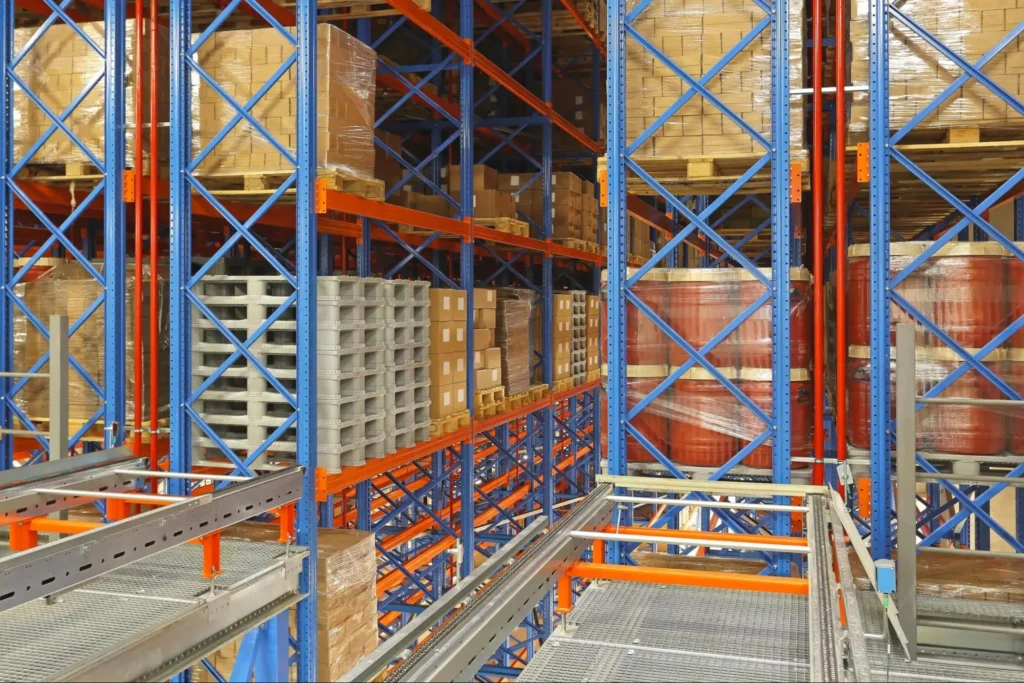
Automated racking systems store pallets in dense, vertical configurations where robotic cranes or shuttle systems place and retrieve loads without human guidance. The mechanical precision of these systems means that every load must conform to tight dimensional tolerances.
The concept becomes critical in automated racking. A forklift operator can eyeball a slightly off-spec pallet and compensate in real time. An automated crane or shuttle system follows programmed coordinates exactly, with no ability to improvise. If the pallet does not match the system’s expectations, the line stops.
Consider it this way: a distribution center running an ASRS with 40-foot storage aisles and racking designed for specific load profiles needs pallets that are dimensionally identical every time. If pallet height varies, loads may not clear overhead rails. If deck boards are inconsistent, conveyor sensors reject the load. If the pallet footprint is off by even a fraction, the automated crane cannot seat the load correctly.
This is important because every rejected load in an automated racking environment costs time, labor and throughput. In high-volume operations moving thousands of loads per day, even a small percentage of rejections compounds into significant downtime.
Millwood’s Engineering Team approaches this challenge the same way they approach all pallet design. They study each customer’s entire application before recommending a solution.
Using the Pallet Design System (PDS), engineers test deck board configurations, stringer specifications and load patterns in real time to confirm that each pallet meets the system’s requirements before it enters production. This, in turn, facilitates a smoother operation aligned to the realities that large-scale automation requires.
Pallet Automation in Practice: Engineering for Consistency
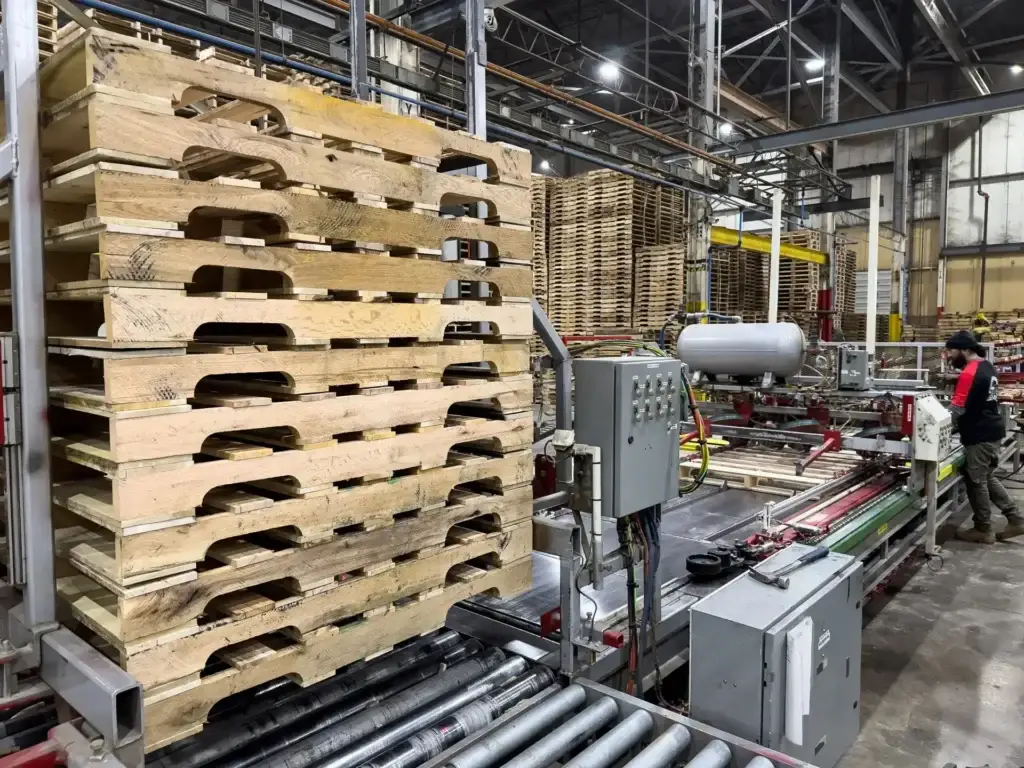
Pallet automation is not limited to the warehouse floor. It also describes how pallets themselves are manufactured with automated and semi-automated systems that deliver greater consistency than manual assembly alone.
Millwood’s in-house operations include proprietary automated systems that combine light automation with flow-line production to achieve higher throughput and improved ergonomics for Team Members.
Automated paint lines and pallet stackers run on the back end of repair lines with minimal human input beyond starting, stopping and managing jams. These systems free Team Members to focus on tasks that require strategic judgment and specialized skill.
Millwood’s Engineering Team has long held that automation and autonomy are not synonymous. Automation requires minimal human input to operate, not zero human input. Most automation technology at Millwood has been implemented alongside Team Members to make their work less physically demanding and to improve operational efficiency. This approach also allows Millwood to hire from a wider demographic because the work is safer and less physically taxing.
For operations leveraging advances in automation, the quality of every input directly determines the quality of the output. Partnering with a pallet manufacturer that combines automated production systems with skilled human oversight means receiving precisely engineered pallets, built to exact tolerances, every time. That kind of supplier quality control does not just support your automated production line. It helps guarantee better outcomes from it.
Unit Load Thinking: The Missing Piece
Most pallet conversations focus on the pallet itself. Dimensions, material, price per unit. That approach worked when most warehouses were manual. Automation changes the equation. It places unit load thinking front and center of the automation revolution.
The unit load refers to the complete system: the product, the pallet, the stretch wrap, the internal supports and how they all interact with racking, conveyance and storage systems. Applying a unit load perspective means engineering the pallet as part of this whole system rather than in isolation.
Practically speaking, a Procurement Team evaluating pallet options for a new automated facility must consider product weight and dimensions, racking type, conveyor specifications, stretch wrap containment force and storage density goals. The “best pallet” changes depending on these variables. A 48×40 stringer that works perfectly for one application may fail in another because the load profile, wrap spec or racking configuration is different.
Automation therefore raises the stakes on every pallet decision because the system has no ability to compensate for a mismatch between components. The right answer is not simply “a better pallet.” It is engineering the right pallet in context of the full unit load.
Millwood’s Packaging Science capabilities exist specifically for this type of analysis. From SolidWorks modeling to ISTA-certified lab testing that replicates real-world transport conditions, every design is validated against the actual operational environment it will enter. The goal is a solution that balances cost, strength and safety for the specific application.
Millwood SURE: Engineering the Right Pallet for Automated Environments
Millwood does not sell pallets as if they were commodities and hope they work. We learn what the customer’s pallet is being used for, and then we determine the solution that fits their needs.
This includes the pallet, the wrap and the internal and external supports that make up the full unit load.
We call this approach Millwood SURE:
- Study customer goals and challenges. We want to understand every product and system variable: weight, stack height, temperature range, rotation frequency and automation parameters.
- Understand and engineer proven solutions. Use PDS software to develop pallet designs optimized for the specific conditions and handling requirements specific to your product.
- Review and verify with rigorous testing. Run compression and deflection testing in Millwood’s ISTA-certified lab, simulating real-world stresses to cut down on headaches later.
- Expand and scale with long-term measurable value. Move validated designs into production and deliver consistent, lab-certified pallets on schedule so that your facilities can operate with confidence.
This process reflects a philosophy Millwood’s engineering Team has maintained through decades of manufacturing: automation carries inherent risks to personnel working around machinery. Combining well-designed systems with thorough training and a culture of safety minimizes those risks. With advancing technology, Millwood continues to build and install reliable equipment that protects both the product and the people.
Organizations that embrace automation early are better positioned for recovery during market disruption. Those heavily reliant on manual labor alone face greater vulnerability to workforce shortages and economic volatility. Through automation in its own facilities, Millwood absorbs disruption more effectively and passes that resilience on to customers through consistent supply and quality.
PalletView, Millwood’s proprietary tracking system, adds another layer of confidence for customers managing pallet pools across automated facilities. Real-time visibility into pallet counts, locations and conditions helps Procurement Teams make data-driven decisions about inventory and replacement cycles.
Choosing a Pallet Partner for an Automated Future
Technology is not something to fear. It is something to use wisely. Every advancement in supply chain automation creates new potential for efficiency, throughput and safety. It also raises the standard for every component in the system, including the pallet.
The question for Procurement Teams is not whether automation will reach their facilities. It is whether their pallet program is ready when it does.
What to look for in a pallet partner for automated environments:
- Scale to support multi-location operations nationwide.
- Manufacturing consistency backed by automated production systems.
- Testing and validation infrastructure (ISTA-certified lab, PDS modeling).
- A track record of solving real automation challenges under real deadlines.
- Engineering capability to design pallets for specific automation applications.
- Unit load perspective that considers the full system rather than just the pallet.
Millwood operates more than 40 manufacturing and repair facilities, with more than 250 strategic partners across North America, processing over 200 million pallets per year. That infrastructure exists to serve one purpose: delivering the right packaging solution to the right place on time, every time.
Connect with a Millwood packaging expert to evaluate your pallet program for automation readiness.