“U.S. manufacturing executives entered 2026 facing uncertain macroeconomic conditions as they set out to drive top-line growth while protecting margins against an increasingly unpredictable backdrop of inflation, renewed tariff threats, supply chain disruption and broad economic uncertainty. The conflict with Iran, a shifting trade policy agenda and softening consumer sentiment have together raised the cost of getting strategy wrong.”
– Priorities and Strategic Imperatives for US Manufacturers, L.E.K. Consulting (2026)
The last few years have been a wake-up call for businesses everywhere. From supply chain disruptions caused by wars in Europe and the Middle East, to changing tariff regimes and inflationary pressures on raw materials, companies across the industrial machinery and equipment sector have realized just how exposed their operations can be, especially in uptime-critical environments where even minor material-flow interruptions ripple directly into production delays.
Relying on a fragmented supplier base, juggling multiple purchase orders or treating packaging and logistics as an afterthought is no longer sustainable. This is particularly true in heavy-equipment and complex-assembly operations where load stability, weight tolerance and cycle-time alignment matter.
Instead, industry leaders are increasingly discovering how strong supply chains start with reliable, consolidated supplier relationships. In other words, strategic sourcing, a smarter, more intentional approach to procurement that goes beyond short-term cost-cutting and focuses instead on long-term resilience, efficiency and trust.
Below, this article will examine five ways strategic sourcing for manufacturers can positively impact your bottom line, drawing on real-world examples from decades of experience serving companies of all sizes in the industrial machinery and equipment industry.
1. Cost Savings: Eliminating Redundancy, Unlocking Value
“The techniques expected to drive the greatest increase in savings and value realization in 2026 are supplier negotiation, strategic sourcing, category management, contract review and demand management.”
– The Hackett Group (2026)
In cost-reduction discussions, the focus can quickly shift to short-term staff layoffs, tightened budgets and cheaper materials. In Millwood’s 40-plus years of experience, however, that means missing out on one of the most reliable Total Cost of Ownership (TCO) levers available, vendor consolidation.
Working with multiple vendors across a wide footprint can create unnecessary complexity in the form of different contracts, misaligned payment terms, overlapping SKUs and varying specifications. In machinery and equipment applications, unmanaged SKU proliferation also complicates Maintenance, Repair and Operations (MRO) planning and point-of-use availability. Financially speaking, these inconsistencies can quickly add up.
Every additional vendor means another invoice to process, another set of freight schedules to coordinate and another layer of administrative oversight. The result is a tangled web of processes that consume your time and budget.
The financial leakage doesn’t stop there. When you spread purchases across too many vendors, you risk diluting your buying power, making it harder to negotiate favorable rates or volume discounts.
This is where strategic sourcing for manufacturers steps in. Industry experts point out how strategic sourcing can reduce verified purchasing, freight, inventory, handling or administrative costs that creep in when too many suppliers are involved. By consolidating your vendor pool, your business could streamline purchasing, standardize specs and unlock volume-tier pricing.
What might that look like in practice? Take the example of a global manufacturer that approached Millwood after discovering their pallet waste and disposal costs were spiraling, exceeding $60,000 per month.
Millwood’s on-site analysis and Packaging Science testing uncovered the root issue. The pallet spec provided by their previous supplier was not suitable for the scale of their operation. Millwood replaced the incorrect spec with a proven, durable, reusable pallet engineered to support higher-volume performance, then established a dedicated repair-and-return facility less than 10 miles away. This custom solution reduced waste, eliminated unnecessary pallet purchases and transformed what had been a major cost center into a circular, value-generating workflow.
This manufacturer now recovers and reuses approximately 8,000 pallets every month (96,000 annually), achieving an estimated $2 million in annual savings from disposal fees and reduced new-pallet purchasing costs. These results are a model example of strategic supply in action, of the kind Millwood hopes to share with every customer.
2. Supply Chain Efficiency: Streamlining for Scalability
“Managing the influx of raw materials and components into manufacturing plants has historically been plagued by fragmented supplier schedules, erratic cargo volumes and a lack of real-time transparency. Leading manufacturers are treating the inbound network not merely as a cost centre, but as a strategic asset.”
– Manufacturing Digital (2026)
Running a supply chain with multiple vendors can feel like herding cats. Every additional supplier is another variable that requires time and energy to manage, from delivery timelines to quality control to invoicing. When everything is running smoothly, you may be able to keep up. But during periods of rapid growth or global disruption, those extra moving pieces can quickly overwhelm your Team.
Strategic sourcing can help to minimize those moving pieces. By consolidating your supply chain with a trusted solution provider like Millwood, you can reduce the number of variables and make your processes more predictable and dependable, particularly when supplier performance must match takt-time requirements and support steady throughput.
Procurement is smoother with fewer invoices and fewer phone calls. Forecasting and Sales and Operations Planning (S&OP) alignment improve when your supplier understands your network, mix and seasonality. Scaling to new locations becomes repeatable and low-risk when every facility uses the same packaging specifications and logistics processes.
This is where working with a strategic provider of industrial packaging solutions can make a real difference, especially when that provider offers extensive sourcing and manufacturing capabilities. Millwood operates 40-plus facilities, works with over 250 strategic partner locations and has more than 2,000 Team Members spread across North America, which facilitates local service with national On-Time-In-Full (OTIF) consistency.
Consider a global leader in industrial transportation equipment whose production line requires rapid response times to fulfill orders. When their previous 3PL couldn’t keep up, they turned to Millwood for a solution that could match the pace of their operation. Today, Millwood runs two dedicated facilities just a few hundred yards from the customer’s plant, managing their crating, pallet, packaging and load securement needs in lockstep with real-time production.
By centralizing their industrial packaging solutions with Millwood, including crates, pallets and load securement, the customer now manages 40-50 active SKUs through those two dedicated facilities, replenished continuously to match shifting production priorities.
On an average day, Millwood delivers up to 25 full truckloads across two shifts, maintaining 100% on-time delivery and eliminating the downtime and material-flow delays that had previously constrained throughput. That level of real-time support is what scalable supply chain efficiency can look like in practice.
3. Consistency & Quality Control: Raising the Bar Across Your Network
“As organizations recognize that quality issues can quickly erode apparent savings, sophisticated procurement teams are elevating quality control from a technical consideration to a strategic imperative. This evolution reflects a fundamental truth: the most significant procurement costs often stem not from purchase price but from quality failures that cascade through operations.”
– The Quality Control Process, Global Sources (2025)
Inconsistent standards for industrial equipment packaging could be a quiet but hugely costly risk in your supply chain. When every facility uses a different spec, whether for pallets, crates or packaging, you’re left with unpredictable performance, unreliable load capacities and varying safety standards. Over time, these inconsistencies translate into product damage, inefficiencies and frustrated employees who are left guessing from one shipment to the next.
Strategic sourcing directly addresses this issue by consolidating procurement under one reliable partner. With strategic sourcing and standardized solutions, you ensure that every pallet, crate or custom packaging solution performs the same way, no matter where it’s manufactured or shipped.
This approach not only reduces rework, waste and handling errors, but also simplifies quality control and compliance. Instead of monitoring a dozen vendors with different standards, you have one partner accountable for your industrial equipment packaging requirements.
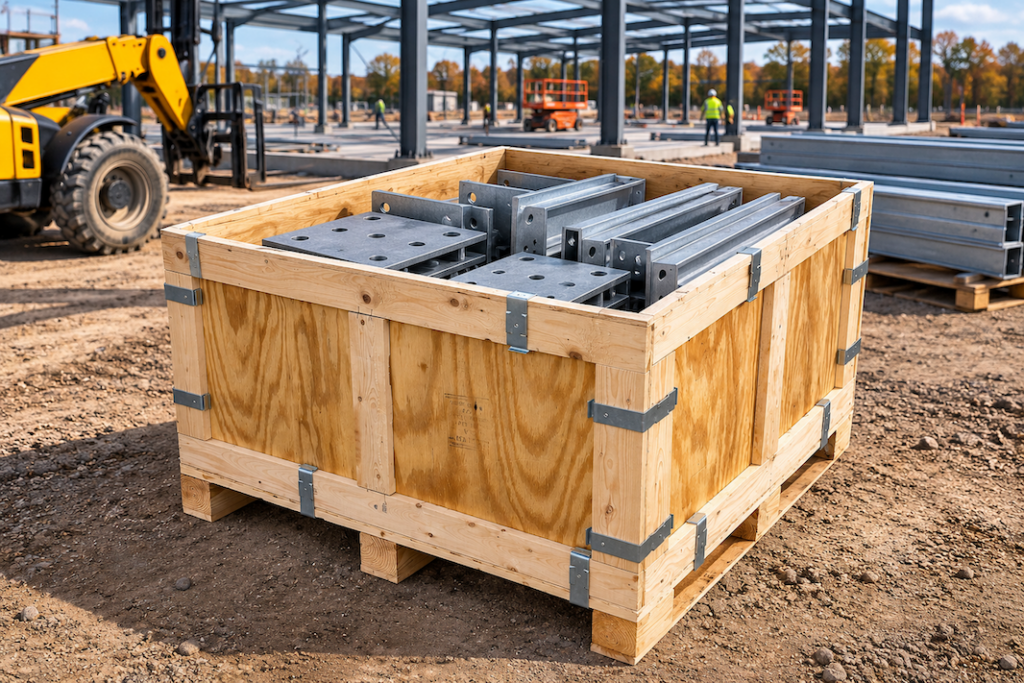
One of Millwood’s industrial equipment manufacturing customers experienced the value of custom industrial packaging firsthand when they invited us to rethink the crates they used to ship steel components to job sites. Previously relying on an off-the-shelf crate model, they faced recurring issues. Employees reported uncomfortable pinching from awkward metal clips, panels felt too flimsy to reliably protect loose metal components in transit and unmarked crates made it hard for Teams to quickly locate mission-critical components on site.
Leveraging decades of design expertise, Millwood’s Team visited the plant, listened to operators and managers, and engineered a custom crate design with four targeted changes: a protective plywood collar around the latches, increased panel thickness for greater durability, integrated skids for tool-free handling and stenciled branding for clear identification at job sites. Those design decisions turned a generic crate into a just-right solution that behaves the same way in every shipment: stronger, safer and easier to work with from plant floor to final assembly.
More than that, the attention to detail and person-first approach throughout the process, starting with on-site conversations and ending with a crate tailored precisely to their workflow, secured their trust.
The redesigned crate addressed pinching complaints, improved protection for industrial equipment components and gave the manufacturer confidence that each clearly branded crate would arrive intact and easy to identify at the job site, a visibility improvement that directly supports installation readiness and reduces cycle-time losses during field assembly.
For this customer, custom packaging for industrial manufacturing is backed by an ongoing relationship. If a new logistics or quality concern appears, they know who to call.
4. Risk Reduction: Building Resilience Through Fewer, Stronger Partners
“Integrated planning improves risk management […] Best-in-class companies […] integrate suppliers in forecast and demand planning. Instead of keeping vendors at arm’s length, they are building deeper, more transparent partnerships.”
– Procurement Redesigned for Uncertainty, Bain & Company (2025)
Supply chain risk has intensified across logistics, inputs and regulatory compliance. Ongoing conflicts in Europe and the Middle East, combined with uncertain tariff regimes at home and abroad, have demonstrated just how vulnerable industrial machinery and equipment operations are to disruptions, with ports closed, material shortages and delayed shipments becoming increasingly common. Many companies that rely on multiple vendors have found themselves scrambling, with no single point of accountability and no clear way to fix problems efficiently.
Strategic sourcing can reduce this exposure by creating a direct relationship with a trusted solution provider who takes responsibility for your needs. A key benefit of strategic sourcing for manufacturers is clearer accountability that means knowing exactly who to contact when a packaging or delivery issue threatens production. Instead of chasing down 20 different contacts across the country, you can rely on one Team to resolve logistics issues quickly and decisively.
Partnering with a vertically integrated supplier like Millwood also helps mitigate raw-material availability and price-volatility risk. Millwood’s robust supply chain allows us to provide and deliver at scale, leveraging our facilities, buying power and longstanding strategic partner relationships. In this way, strategic sourcing can secure supply, manage volatility and ensure continuity of service, even in challenging markets. For IME manufacturers, that continuity directly translates into safeguarded uptime and minimized unplanned maintenance events.
Millwood’s relationship with the industrial transport manufacturer mentioned earlier is an example of risk reduction in real time. When they first became a customer, their previous 3PL was operating at 98-99% on-time. Those margins were acceptable on paper, but not enough for their live, globally critical production line.
By embedding a Team Member inside their facility and operating two dedicated locations right next door, Millwood created a fully integrated packaging and crating solution engineered around their live demand, dramatically reducing the risk of missed deliveries, bottlenecks and unplanned line stoppages.
Or, for another real-world example demonstrating how design-led partnership can reduce risk, consider the industrial equipment manufacturer highlighted in the previous section. Their previous off-the-shelf crates led to safety concerns, fragility during transit and confusion when unmarked crates were challenging to locate on the job site.
By listening on site and redesigning a crate solution with shielded latches, thicker panels, integrated skids and stenciled branding, Millwood helped to eliminate pinching complaints, improve protection for solid steel components and make critical parts faster to locate on job sites, reducing safety concerns, material loss and downstream assembly delays where it mattered most for the customer.
There are examples from other customers in the industrial machinery and equipment industry we could highlight that echo the same point. Whenever customers have faced a procurement issue, Millwood’s expansive strategic sourcing network has been able to step in and protect their interests, absorbing the risks so they don’t have to.
5. Sustainability & Innovation: The Future of Strategic Sourcing
“By 2030, circularity will change the way large sectors of the machinery and equipment sector operate. Profit pools will shift as companies embrace business models that preserve materials and extend the life span of machinery. Circular operating models will reconfigure value chains. And as companies begin to decouple their growth from resource consumption, a new set of winners and losers will emerge.”
– Global Machinery & Equipment Report, Bain & Company (2024)
In today’s industrial machinery and equipment marketplace, sustainability is not just a corporate initiative but an operational imperative. Consumers, retailers and investors all want proof that industrial manufacturers are reducing waste, using resources responsibly and aligning with ESG standards and customer scorecards. Sustainability performance may even be tied to winning contracts and maintaining a strong reputation.
When supply chain management is split across multiple vendors, it can be hard to stay on track with sustainability goals. One supplier may use recycled materials, while another relies on virgin resources. One may comfortably meet regulatory standards, while the other falls considerably short. Vendor variability can make consistent ESG reporting a nightmare, and can easily weaken your overall green score.
Strategic sourcing can solve this by consolidating packaging and logistics solutions under just one or two trusted partners who drive sustainable innovation and auditable reporting across your network. With Millwood, for instance, customers can purchase reconditioned and recycled pallets, rely on us for their pallet and lumber recycling needs and integrate on-site repair-and-return programs that contribute to a circular economy. One vendor, multiple measurable sustainability gains.
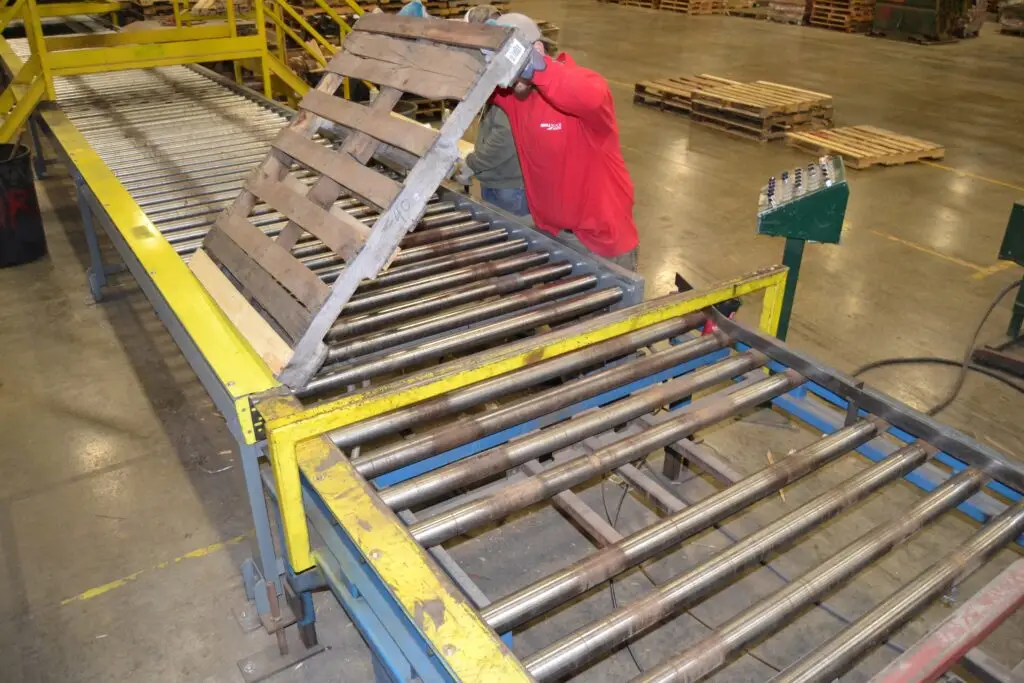
Millwood is also measuring progress across its own supplier relationships and operations. In 2025, we recycled nearly 67 million pallets and diverted approximately 53 million pounds of material from landfills through CORE initiatives. Millwood’s latest annual sustainability report documents supplier Code of Conduct participation rising from 42% to 59%, along with our first company-wide Scope 1, 2 and 3 emissions baseline.
It doesn’t stop there. Designing and testing custom industrial packaging in the ISTA-certified Millwood Lab can identify opportunities for customers to reduce material waste while protecting product performance.
For a clear example of that kind of sustainable waste reduction, consider the industrial transport manufacturing customer whose operations Millwood supports with an embedded Team. As discussed, that solution has focused on designing smarter packaging and crating solutions that increase speed and operational efficiency.
By working on-site and engaging directly with the customer’s engineers, Millwood has helped refine crate designs, improve performance and realize ongoing efficiency gains, aligning resource use, specifications and replenishment cycles to true line demand in real time, bolstering their environmental profile and demonstrating how sustainability and innovation can go hand-in-hand.
Explore the 2026 Sustainability Report for more on Millwood’s progress in recycling, responsible sourcing and environmental measurement.
Stronger Vendor Relationships = Stronger Supply Chains
At the heart of strategic sourcing is a simple truth. When you reduce the number of outside suppliers, you free yourself to invest more deeply in the partnerships that matter most, just as in the examples cited throughout this article.
As those close-knit business relationships have shown, fewer suppliers means fewer points of failure, clearer communication, tighter forecasting and a stronger alignment over long-term sustainability and growth goals.
For companies of any size in the industrial machinery and equipment sector, strategic sourcing for manufacturers starts with a practical question. Which supplier relationships can help reduce complexity and support dependable performance across your operations?
Millwood has built its business on being a solution provider to companies across all industries: a partner you can trust, regardless of your logistics needs. Time and again, customers have seen how working together through a strategic sourcing strategy has transformed their frustration to confidence, chaos to clarity. Millwood has developed a proven, repeatable process to make this work: Millwood SURE.
Millwood SURE
The SURE Process optimizes your packaging and supply chain with custom design, integrated manufacturing, proven testing and sustainable impact, over four clear stages:
- Study: Millwood works with you to assess your operations, product flow, challenges and goals and gain a comprehensive picture.
- Understand: Millwood engineers custom packaging for industrial manufacturing around your exact needs, supported by data and real-world performance insights.
- Review: Millwood verifies with testing, field validation and adjustments to ensure reliability and consistency.
- Expand: Your organization will be empowered to grow and scale with successful results across sites, networks or product lines for long-term efficiency and measurable value.
Millwood’s process and capabilities are built to deliver. With over 40 Millwood-operated facilities, 250+ strategic partner locations, and more than 2,000 Team Members in North America, Millwood is ready to design, test and deliver solutions that can be replicated across your network for maximum impact, saving you time and money, reducing complexity and building a supply chain that will support your organization for years to come.
Connect With Millwood to discover how strategic sourcing could solve some of your biggest challenges.
See How Millwood Has Helped Others and discover how vendor consolidation can drive long-term value, growth and sustainability.