Comparing pallet size by industry does not provide a one-size-fits-all answer. While the 48×40 accounts for roughly 35% of total pallet production in North America, the majority of the market is served by other pallet dimensions and custom specifications. The specs that actually protect your product, comply with regulations and perform in your handling environment depend largely on your industry.
That reality shapes everything Millwood, Inc. does as a national pallet and packaging solutions provider. The right pallet is not the one that fits a generic chart. It is the one engineered for how your product moves, where it moves and what it encounters along the way.
“We’re going to try to give you the best total solution cost-wise for what you do,” says Lee Evans, Senior VP of Sales and Marketing at Millwood, Inc.
This guide maps the most common pallet sizes and requirements across the industries Millwood serves, so you can evaluate whether your current specs are working as hard as they should. Understanding pallet dimensions by industry is the first step toward specifications that actually perform.
Why Pallet Size Varies by Industry
The “right” pallet size is shaped by forces that go far beyond the product sitting on top of it. Product weight, fragility and container shape (drums versus cases versus bundles) all drive dimensional decisions. So does the handling environment. An automated distribution center running tight tolerances operates in a completely different world than an outdoor lumber yard with manual forklifts.
Regulatory requirements layer on additional constraints. FDA guidelines, ISPM-15 treatment standards, DOT hazmat protocols and retailer mandates each narrow the field of acceptable specifications for specific verticals.
The cost of getting it wrong is real. Product damage, compliance failures and wasted trailer space all trace back to pallet decisions that treated dimensions as a commodity choice rather than an engineering one.
For a deeper look at how to read and compare pallet specifications, see Pallet Dimensions Explained.
Food & Beverage
Food and beverage is the single largest consumer of 48×40 pallets in North America, both new and recycled, and by a wide margin. The dominant food industry pallet size remains the standard 48×40 GMA stringer pallet (new and recycled A1/A grade), with combo pallets offering cost optimization at scale and 36×36 pallets still serving certain bottling operations.
The block pallet shift. While the standard pallet size in food and beverage remains the 48×40 stringer, one of the most significant sourcing shifts is the growing demand for 48×40 block pallets.
Evans points out that shifting big-box requirements are flooding the recycled block pallet pool: “Places like Costco are requiring people to send things in on block pallets rather than stringer pallets, so there’s more out there in the world – more than we can find homes for.”
That retailer-driven shift is creating both supply and demand opportunities. Recycled block pallets are now available at significant savings compared to new builds, and operations investing in automated storage and retrieval systems (ASRS) increasingly require their dimensional precision and true four-way entry.
Pallet grade matters here. Choosing the right pallet size for shipping food is only half the equation. When sourcing recycled pallets for food applications, the grade is everything. According to Millwood’s verified grading system, Premium A1 and Grade A recycled pallets are the standard for food and beverage, featuring no stringer repairs, controlled deckboard spacing and verified load ratings.
Evans warns that food and beverage buyers shouldn’t go with the cheapest pallet: “When they don’t get the exact spec on a recycled pallet, they end up suffering from the gap in quality.”
Mold prevention is the defining hygiene concern in food and beverage, more so than any other sector. Kiln-dried treatment, plastic pallet alternatives and pressed wood options all play a role in environments where product safety is non-negotiable.
Beyond the pallet itself, food and beverage operations typically pair their pallets with slip sheets, stretch film, damage control products and, increasingly, point-of-purchase display pallets for retail environments.
Chemicals & Related Products
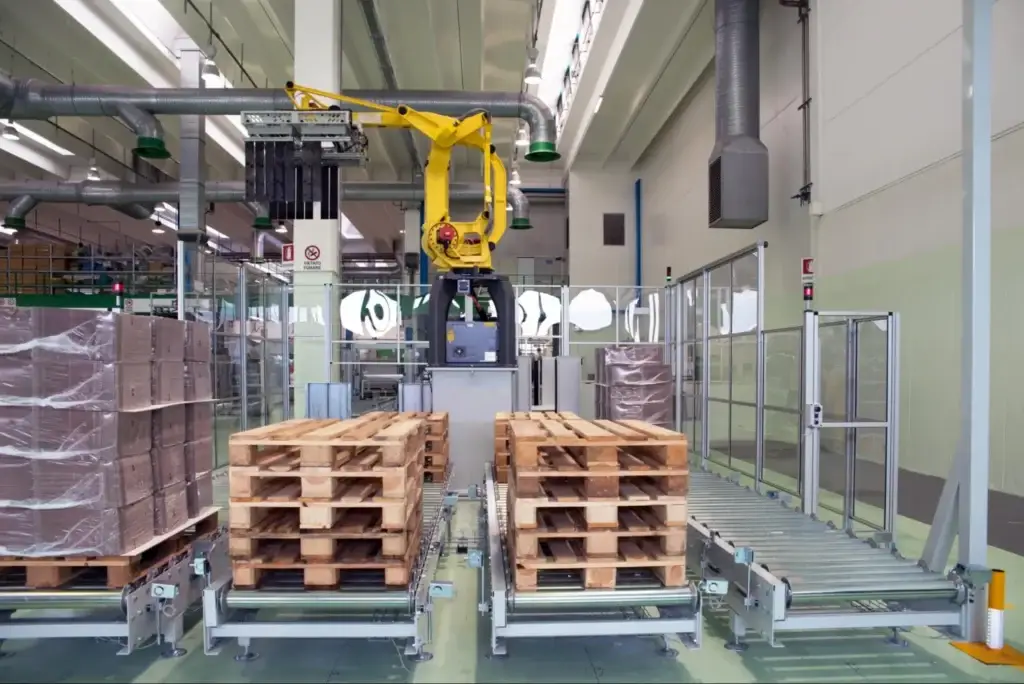
Chemical pallet sizes follow their own dimensional standard: the CP pallet family. Standardized by CEFIC over three decades ago, CP pallet dimensions span nine designations (CP1 through CP9), measured in millimeters and purpose-built for the cylindrical containers, FIBC bags and heavy loads that define chemical distribution.
Beyond the CP family, 48×48 pallets are common for four-drum configurations (55-gallon drums), and 44×44 pallets serve certain chemical applications.
Construction almost exclusively consists of new pallets as chemical loads are dense, hazardous and unforgiving of structural failure. Heavy-duty hardwood is standard because no one in this industry tolerates the risk of a pallet giving way beneath 55-gallon drums of product.
The design challenge is precision.
Evans notes that the chemical industry’s challenge is avoiding overkill: “It’s the balance between safety and not spending too much money. These can be very expensive pallets.” Over-engineering drives up cost unnecessarily; under-engineering risks catastrophic failure. Millwood’s Packaging Science Lab, our dedicated testing facility for load validation and pallet engineering, can help customers validate designs to find the right balance through testing rather than guesswork.
Complementary products for chemical operations include FIBC bags (powdered chemicals typically ship in these bulk containers), damage control products like wood packs that prevent load shift, and strapping for securing drums and totes.
Pharmaceutical
Pharmaceutical pallet requirements center on one non-negotiable principle: zero tolerance for contamination. Mold is an absolute non-starter, and every preventative measure, from material selection to moisture control, ranks high on the specification list.
Dominant sizes: 48×40 and 48×45, almost exclusively in the form of new pallets. Kiln-dried pine stringer pallets are the standard specification.
Even though pharmaceutical products are heavily packaged (boxed, then boxed again, often within another outer case), contamination standards apply to the entire environment. Mold introduced by a pallet into a controlled facility is unacceptable regardless of whether it ever contacts the product directly.
Pallet alternatives play a significant role in pharma. Plastic pallets eliminate moisture and mold concerns entirely. Pressed wood pallets offer a cost-effective middle ground with inherent mold resistance. Both meet ISPM-15 standards for global pharmaceutical distribution without additional treatment.
Recycled pallets are rarely acceptable in pharmaceutical environments because the contamination risk, however small, conflicts with the industry’s regulatory framework and risk tolerance.
Building Materials
Building materials pallet specifications are among the most diverse and customized in the industries Millwood serves.
The defining characteristic: custom engineering.
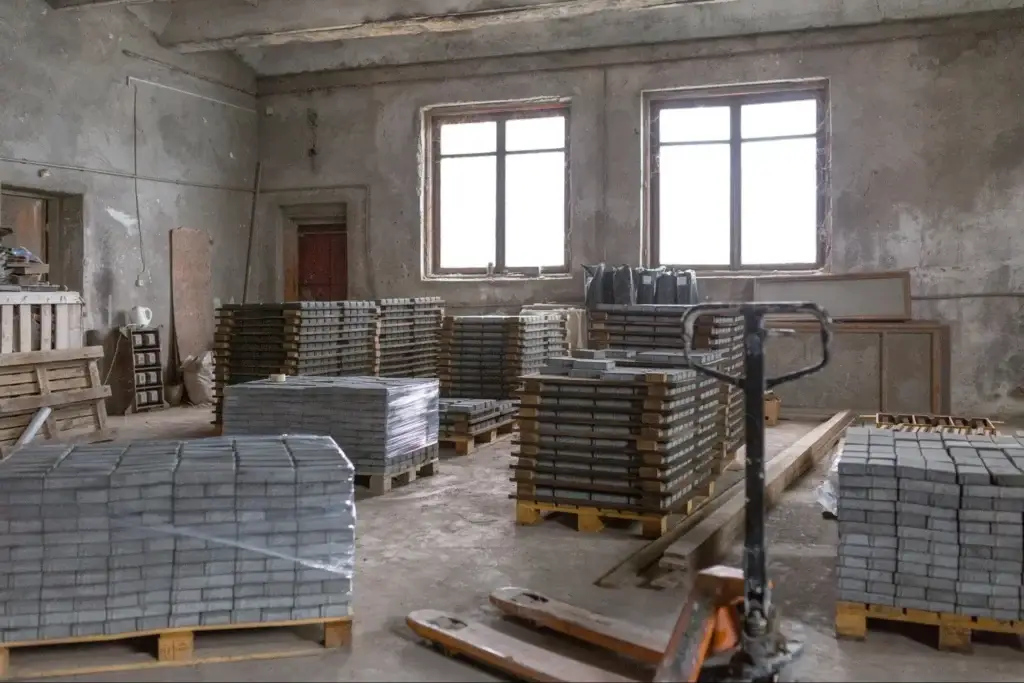
Evans explains that building materials customers need highly tailored solutions: “Their pallets are very customized to fit not only their product, but their use, durability, everything. They’re highly engineered pallets.” Standard sizes are rare because the products themselves (shingles, siding, tubs, windows, concrete block) vary so dramatically in weight, shape and handling requirements.
Building products are heavy and frequently shipped without secondary packaging. Unlike food or beverage, where corrugated is the primary packaging spend, building materials often sit directly on the pallet with minimal additional protection. That makes the pallet itself the primary packaging investment, and it puts cost sensitivity and structural performance in direct tension.
Construction is typically new custom stringer pallets built with heavy-duty engineered stringers, often hardwood. Recycled 48×40 pallets are uncommon in this sector precisely because of that direct load exposure. Crating solutions integrate with pallets for fragile building products like tubs and windows, and Millwood’s Packaging Science Lab validates designs through load testing before production begins.
→ Discover how strategic sourcing with Millwood fuels a building materials partnership.
Additional Industries: Quick Reference
Glass & Clay: Pallets used in the glass industry follow a standard industry spec, but the variety of glass products (flat glass, bottles, windshields, containers) means significant variation in supporting packaging. A-frame crating is common alongside pallets for flat glass, top frames secure stacked loads, and slip sheets separate layers. Strapping is used extensively. The Millwood Lab is particularly valuable here for validating load configurations across different glass types.
Plastics Packaging & Containers: Plastics packaging shares many characteristics with food and beverage. New and recycled 48×40 stringer pallets dominate, and mold prevention is relevant because these manufacturers serve food and healthcare customers who demand cleanliness. Top frames are used for lighter loads like empty containers. Supply chain reliability is a primary concern.
Evans emphasizes that reliability is non-negotiable in plastics packaging: “These customers are serving very large companies who are very demanding, and those companies need what they need when they need it.”
Industrial Machinery & Equipment: Crating is the first word in industrial machinery packaging. Consequently, industrial pallet dimensions are rarely standard. That means custom pallets with oversized footprints, holes drilled for bolt-down features, lab-designed for extreme loads. Loose lumber is common because many operations build their own blocking and bracing on-site around equipment sitting on the pallet. Cost per pallet is rarely the primary concern here.
Evans says that damage prevention is the top concern for industrial machinery shippers: “They’re more concerned with getting it there safely in one piece, because the equipment can be very, very expensive.
Aerospace & Defense: Similar to industrial machinery in product requirements: crating, custom pallets, lumber, Mil-Spec compliance. The key distinction is that government contracts and specifications are fixed. ISPM-15 treatment is mandatory for international shipments, and a capability statement is often required before a supplier even enters the conversation.
3PL (Third-Party Logistics): 3PLs must accommodate multiple industries simultaneously. 48×40 GMAs (new and recycled) are the backbone, but the tension between standardization and flexibility defines this sector.
Evans notes that 3PL contracts leave little wiggle room on cost: “Their contracts aren’t very forgiving, so cost savings and supply chain security are both at the top of the list.”
Block pallets are growing as automation expands across 3PL facilities.
Pallet Size by Industry: Comparison Table
| Industry | Common Sizes | Typical Pallet Type | Key Requirements | Standard Material |
| Food & Beverage | – 48×40 – 36×36 | Stringer & Block (new, recycled A1/A, combo) | Mold prevention, grade consistency | Softwood, hardwood |
| Chemicals | – CP1-CP9 – 48×48 – 44×44 | New custom stringer/block | Heavy-duty, DOT/OSHA compliance | Hardwood |
| Pharmaceutical | – 48×40 – 48×45 | New stringer, plastic, pressed wood | Mold-free, moisture-controlled, ISPM-15 | KD Pine, plastic, pressed wood |
| Building Materials | – Custom/ non-standard | New custom stringer (heavy-duty) | Load capacity, engineered durability | Hardwood, engineered |
| Glass & Clay | – Industry-specific standards | New block, custom | Fragility protection, weight capacity | Hardwood |
| Plastics Packaging | – 48×40 | New & recycled stringer, GMA | Cleanliness, supply chain reliability | Softwood, hardwood |
| Industrial Machinery | – Oversized custom | Custom with crating integration | Product protection, bolt-down | Hardwood, heavy-duty |
| Aerospace & Defense | – Custom – Mil-Spec | Custom with crating, ISPM-15 treated | Government spec compliance | Treated hardwood |
| 3PL | – 48×40 (primarily) | New & recycled GMA, block | Cost control, multi-industry flexibility | Mixed |
How to Choose the Right Pallet Requirements by Sector
Start with your product and handling environment. What does it weigh? How will it travel? What systems will it interact with? Then understand the compliance requirements specific to your industry, whether that means FDA hygiene standards, ISPM-15 heat treatment, DOT hazmat protocols or retailer block pallet mandates.
Do not default to “whatever we’ve always used” when operations change. As markets shift, retailer requirements evolve and automation imposes new tolerances, your pallet specification should keep pace.
When multiple variables intersect (heavy loads, regulated products, automated handling, multi-facility distribution), Millwood’s Packaging Science Lab can help to validate your specifications through testing, not assumptions.
Connect with Millwood to evaluate whether your current pallet specifications are right-fit for your industry’s requirements and handling environment.
The Millwood SURE Process: Science-Backed Solutions for Every Industry
Every industry has unique requirements. Millwood engineers pallet programs built for yours, not pallets pulled off a generic line. The SURE Process optimizes your packaging and supply chain with custom design, integrated manufacturing, proven testing and sustainable impact, over four clear stages:
- Study: We work with you to assess your operations, product flow, challenges and goals and gain a comprehensive picture.
- Understand: We engineer packaging solutions built around your exact needs, supported by data and real-world performance insights.
- Review: We verify with testing, field validation and adjustments to ensure reliability and consistency.
- Expand: Your organization will be empowered to grow and scale with successful results across sites, networks or product lines for long-term efficiency and measurable value.
Our process and capabilities are built to deliver. With over 40 Millwood-operated facilities, 250+ strategic partner locations and more than 2,000 Millwood Team Members in North America, we are ready to design, test and deliver solutions that can be replicated across your network for maximum impact, saving you time & money, reducing complexity and building a supply chain that will support your organization for years to come.