Pallet dimensions are usually the first specification a procurement professional encounters when sourcing, handling or storing pallets. Standard pallet sizes seem simple: length, width, height. Numbers on a page.
But numbers on a page can either tell the truth or obscure it. Two pallets with identical exterior measurements can perform in entirely different ways once they enter a live operation. One holds up under load, integrates smoothly into racking and transport systems, and supports your supply chain for years. The other looks right on paper but fails in practice, costing time, money and operational confidence downstream.
This guide provides the dimensional data you need to confidently read and compare pallet specifications. But it also introduces something most dimensions guides leave out: the difference between a measurement that means something and a measurement that merely sounds right. Because in pallet sourcing, choosing well the first time is always better than chasing corrections later.
Pallet dimensions refer to the length, width and height measurements that define a pallet’s footprint and profile, typically expressed in inches (North America) or millimeters (international).
Standard Pallet Dimensions in North America
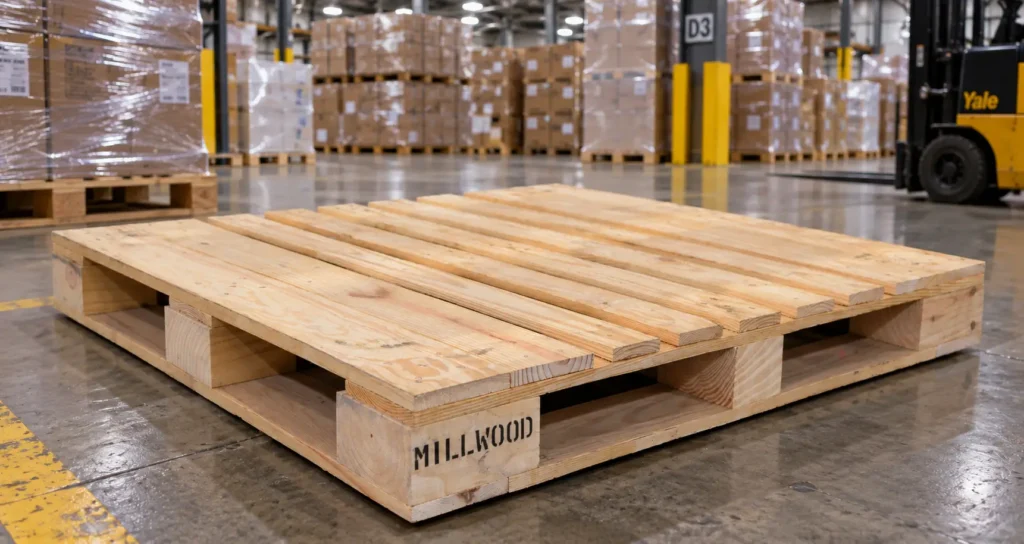
The most common pallet footprint in North America measures 48 inches long by 40 inches wide (“48×40”). According to research published by Virginia Tech, this size accounts for approximately 35% of all pallets produced on the continent and serves as the default across grocery, retail and consumer goods distribution.
The 48×40 standard traces its roots to the now-defunct Grocery Manufacturers Association (GMA), which established the footprint to optimize trailer loading and retail shelf replenishment. Over decades, this size became embedded in warehouse racking, conveyor systems and transportation infrastructure.
Actual dimensions for this pallet footprint include height, which typically ranges from 5 to 7 inches depending on construction type (stringer versus block). Weight ranges between 30 and 70 pounds based on lumber species, moisture content, fastener type and overall build quality.
Understanding where these numbers come from matters because it reveals something important: the “standard” was designed for a specific set of operational conditions. When your operation differs from those conditions, the standard may no longer be the right fit. Treating 48×40 as a universal answer without examining your actual requirements is one of the most common sourcing mistakes in the industry.
Standard Pallet Sizes Beyond 48×40
While 48×40 GMA dominates North American distribution, other common sizes typically serve specific industries and applications. If you’re wondering which pallet size broadly matches your industry, here’s a quick breakdown.
| Dimensions (inches) | Common Application |
| 48 × 40 | Grocery, retail, consumer goods |
| 48 × 48 | Drums, barrels, bulk chemicals |
| 42 × 42 | Paint, telecommunications, HVAC |
| 48 × 45 | Automotive |
| 48 × 42 | Military, aerospace and defense |
| 36 × 36 | Beverages, small footprint operations |
| 48 × 20 | Retail display, half-pallet programs |
Internationally, ISO standard sizes (1200×1000mm and 1200×800mm) serve different logistics networks. The 48×40 GMA pallet does not optimize ocean container space efficiently, which is why export operations frequently use different footprints than domestic distribution.
The above variety exists because different products, handling systems and supply chains demand different solutions. Choosing a pallet size based solely on what is most common, rather than what your operation actually requires, is like selecting a shoe based on what sells the most units nationwide rather than what fits your foot.
How to Read a Pallet Specification
A complete pallet specification can tell you more than overall dimensions. Learning to read it properly is the difference between comparing real performance data and comparing surface-level numbers that may not reflect how the pallet will actually behave in your supply chain.
Key elements of a pallet drawing and what they mean for your operation:
- Length and width: The basic footprint (always expressed as L×W). The measurement provided determines whether the pallet will fit your racking beam spacing, trailer floor plan and conveyor width. A footprint that is even half an inch outside your system tolerances can cause jams, instability or wasted cube space.
- Height: Overall height including deck boards and stringers or blocks. Height directly affects stack limits in storage, clearance in automated systems and how much vertical space each unit load consumes. In high-density environments, every fraction of an inch multiplied across thousands of positions translates into significant gained or lost capacity.
- Deck board count and spacing: Determines how evenly a product’s weight distributes across the pallet surface. Wider gaps between deck boards may save material cost, but they increase point-loading on corrugated packaging, potentially leading to crush damage on heavy or concentrated loads. A specification with fewer deck boards might look identical in footprint but fail to protect your product in transit.
- Stringer or block dimensions: The structural core that determines load capacity and deflection. Thinner stringers flex more under weight, which may be acceptable for light loads but catastrophic for heavy or dynamically handled goods. Block construction distributes force differently and enables true four-way forklift entry, which matters in operations where aisle space is tight or handling speed is critical.
- Entry type: “4-way entry” means forklifts can access the pallet from all four sides. “2-way entry” limits access to two sides. This is not just a handling convenience: in facilities with narrow aisles, automated guided vehicles or high-throughput dock operations, the wrong entry type will slow every single pallet movement across an entire shift.
- Overhang and chamfer: How deck boards extend beyond the support structure. Overhang affects how securely a pallet sits on racking beams and whether stretch wrap anchors properly at the edges. Chamfered (beveled) leading edges are designed to reduce snagging on conveyors and automated systems.
A specification that lists only exterior dimensions without these additional details is incomplete. It may describe what the pallet looks like, even offering basic L×W dimensions, but that lack of depth will ultimately leave you guessing how the pallet will behave once product is loaded, forklifts are moving and your system is running at full speed.
Comparing Specifications: Why Pallet Identical Dimensions Don’t Mean Identical Performance
Two 48×40 pallets from different suppliers can deliver drastically different results despite sharing the same exterior measurements.
Consider the experience of one of Millwood’s customers, a global manufacturer of kitchen, bath and plumbing products, before they were referred to us. Their previous pallet supplier had been providing what appeared to be a functional specification at a competitive price.
But when the pallets were analyzed in Millwood’s ISTA-certified lab, the root cause of their mounting disposal fees and excessive waste became clear: the supplier had been providing the wrong specification entirely, built with materials inappropriate for the scale of the operation.
That single upstream decision, invisible in the basic dimensional data, resulted in over $60,000 per month in waste disposal and tens of thousands of pallets discarded annually. Once Millwood corrected the specification with a proven, reusable design, the customer realized estimated annual savings exceeding $2 million.
Pallet size told this customer nothing about whether their purchase would hold up over time. The L×W numbers looked right. The price was right. But the substance behind those numbers was hollow.
The variables that actually determine performance (lumber grade, fastener type, deck configuration, moisture content, load capacity) never show up in basic dimensional data. They only reveal themselves over time, in the operation, under load.
Why Pallet Dimensions Matter More at Scale
A pallet might look perfectly acceptable sitting by itself on a warehouse floor but when it enters a system built around precision, small dimensional variances can easily cascade into large operational failures.
For instance, when one of the nation’s largest fast-food chains prepared to launch a new, multimillion-dollar automated storage and retrieval system (ASRS), a vendor-supplied specification error of just over two inches in stacked load height threatened the entire project.
In a manual warehouse, that variance might have been absorbed. In an automated system designed with zero tolerance for error, however, it could have halted operations entirely, jeopardizing 136,000 boxes of product per rotation.
Millwood’s Packaging Science Lab worked rapidly with the customer to redesign, test and validate three new pallet configurations, meeting their impending deadline and enabling the facility to open on time with 17,000 system pallets performing exactly as required.
The lesson here is straightforward: Scale amplifies every specification decision. What seems like a minor dimensional detail at the single-pallet level can become a critical variable when multiplied across an automated network. If your operation is growing, investing in new systems or tightening tolerances, verifying pallet dimensions against actual system requirements is not optional. It can be the difference between protecting your investment and gambling with it.
Choosing the Right Pallet Dimensions: The Partner Question
Millwood’s decades of experience in the industry – with hundreds of millions of pallets built, recycled, and repaired annually, and billions over our 40+ year history – have taught us that the best pallet dimensions emerge from a process of collaboration and discovery. That looks like working with real stakeholders in our customers’ operations, not selecting numbers off a generic chart.
When, for example, a national plastics packaging manufacturer found its pallet yard cluttered with seven overlapping 48×40 SKUs performing nearly identical functions, the problem was not dimensional. It was relational. No one had walked the floor with them to ask what they actually needed.
Millwood’s representative spent two full weeks on-site, studying material flow and working alongside the Operations Team. Together, they consolidated seven SKUs into two standardized designs.
That partnership began over twenty years ago. It has never contracted, only grown: from one facility to several, from recycled pallets to load securement, dunnage and comprehensive packaging support.
This pattern is not unique. In the late 1980s, when a manufacturing buyer asked whether anything could be done about used pallets accumulating in her facility, Millwood’s founders did not arrive with a predetermined solution. They walked the plant alongside her, asked questions and responded simply: “Yes, we can do that.” That posture, built on listening rather than selling, now supports the recovery of more than 60 million pallets annually.
The difference between a supplier who hands you a spec sheet and a partner who will help you understand what that spec needs to accomplish is the difference between a transaction and a relationship that compounds in value over time. When evaluating who to trust with your pallet dimensions, look for consistency proven through action, not just claims printed on a capabilities brochure.
Choosing Pallet Dimensions That Deliver: A Practical Framework
1. Start with the product. Your pallet footprint should follow function. What are you shipping? How heavy is it? How will it be stacked, stored and handled?
2. Consider the supply chain. Your pallet moves through racking systems, onto trucks, into warehouses, across docks. The right dimensions need to account for every touchpoint, not just the first one.
3. Think beyond measurements into pallet configuration. Two pallets with the same footprint can be built for entirely different purposes. Lumber grade, deck layout, fastener quality, entry type and load capacity all determine whether a pallet performs or merely occupies space.
4. Engage a strategic partner, not just a supplier. The best pallet decisions are made collaboratively. A partner who takes the time to understand your operation can help you identify specifications that serve long-term goals, not just fill an immediate order.
From standard pallet dimensions to fully custom configurations, Millwood helps customers identify the right pallet for their operation, not just the right measurements. Connect with Millwood to determine which pallet specifications match your application and operational requirements.