ASRS pallets require ±1/4″ tolerances, block pallet construction and racking load performance that standard pallet programs are not designed to deliver. Millwood’s Packaging Science Lab and field engineers design, test and validate ASRS pallets, including captive pallets and system platforms, for automated racking systems that operate with zero margin for error.
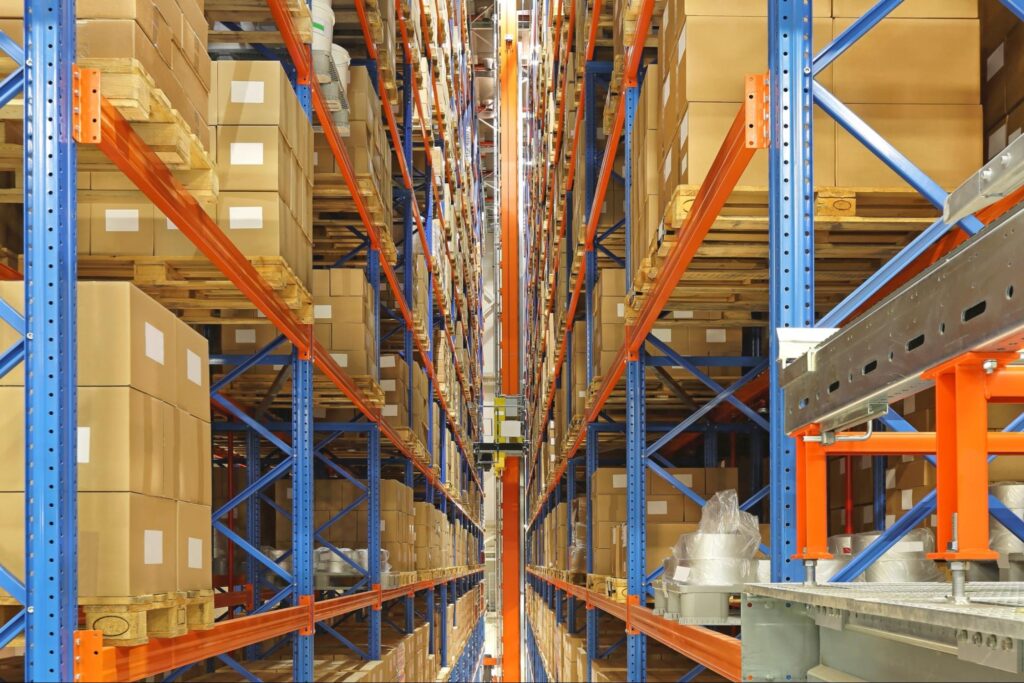
Picture a warehouse the size of several football fields. Robotic cranes navigate 40-foot storage aisles, placing and retrieving thousands of palletized loads per day with precision measured in fractions of an inch. No forklift operators guide the loads. No overhead lights illuminate the aisles. They don’t need to. Why? ASRS technology removes human presence from the racking zone entirely.
When the system operates at full capacity, it is a remarkable achievement of engineering. When it stops, the consequences move quickly from the warehouse floor to the people who depend on it. Production schedules shift. Shipments that stock grocery shelves, supply restaurants and keep distribution networks moving for real communities are delayed. The Team Member troubleshooting the stoppage at 2 AM, the operations staff whose hours get cut when downtime drives budget adjustments, the families fed by the supply chains running through that facility: these are the very human stakes behind every ASRS pallet decision.
As explored in our previous article about automated systems, these systems have zero tolerance for inconsistency. Automated storage and retrieval systems (ASRS) take that principle to its sharpest edge, such that many pallet programs are not engineered for what these systems actually demand. That’s where this article comes in.
What ASRS Demands That Other Automation Does Not
ASRS (Automated Storage and Retrieval System)
ASRS is a warehouse system that uses robotic cranes or shuttle mechanisms to automatically place and retrieve palletized loads from high-density vertical racking. Many ASRS environments operate with minimal or zero human presence on the warehouse floor.
Conveyor systems, robotic palletizers and automated guided vehicles all require tighter tolerances than manual operations. ASRS raises those requirements further still. The system combines extreme vertical storage density, robotic precision and zero human intervention into a single operation. Some facilities run in complete darkness because no person ever needs to enter the racking zone.
Naturally, this creates a specific and unforgiving set of requirements for every pallet that enters the system. These include the following:
- Dimensional tolerances tighten significantly.
Standard manual operations typically allow ±1/2″ of variation in a pallet’s physical dimensions. ASRS environments often require ±1/4″ or tighter.
That quarter-inch gap represents the difference between a load that seats correctly in the racking and one that triggers a full system stoppage.
- Deck flatness becomes a critical performance factor.
ASRS pallets must travel across conveyors and past optical sensors that measure height, alignment and load profile at multiple checkpoints. A warped or inconsistent deck surface triggers load rejections that compound into significant throughput losses across high-volume operations moving thousands of loads per day.
- Racking load emerges as the defining structural specification.
Every pallet bears three types of load: dynamic (while in motion on a forklift or conveyor), static (at rest on a flat surface) and racking (elevated in a rack and supported only at the edges).
ASRS stresses racking load hardest because pallets sit in elevated positions under full weight for extended periods. A pallet designed only for dynamic and static performance may fail under sustained racking stress, and in an ASRS environment that failure has no human observer to catch it before the system reacts.
In short, ASRS compresses every tolerance and amplifies every consequence. The pallet is no longer a passive platform. It is a precision component that the entire system depends on.
Why ASRS Systems Overwhelmingly Require Block Pallets
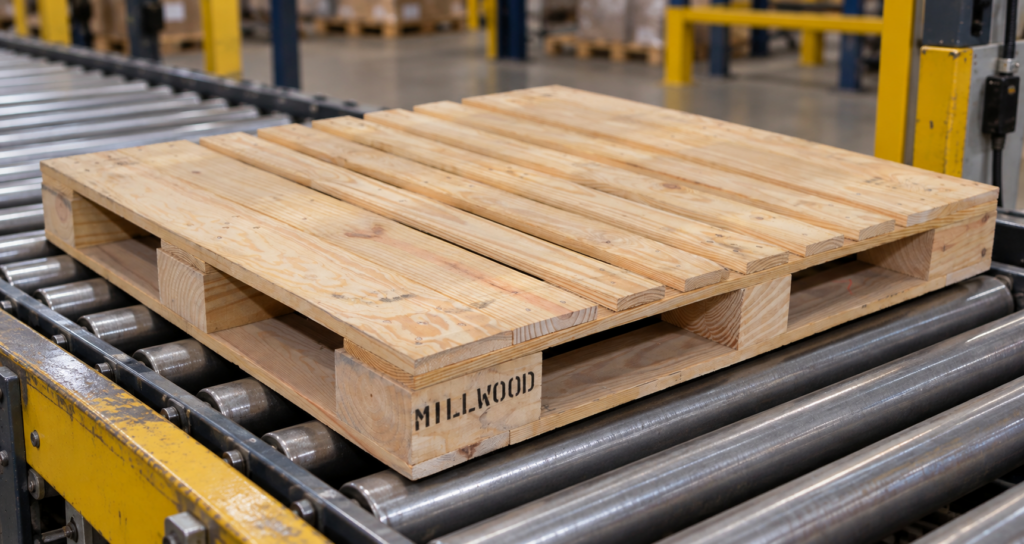
The structural demands of automated racking systems point consistently toward one pallet construction: the block pallet.
The primary reason is four-way entry. ASRS stacker cranes need unobstructed access to the pallet from any direction. Stringer pallets can provide partial four-way entry through notching, yet that process removes material from the load-bearing stringer at precisely the point where racking load performance matters most. Block pallets, on the other hand, deliver full four-way access without structural compromise.
Beyond just entry access, block pallets align with ASRS requirements in several important ways:
- Higher rigidity. Block construction distributes force more evenly across the entire pallet footprint. This reduces the flex that triggers sensor rejections on automated conveyor lines.
- Consistent deck flatness. The block-and-deck-board configuration produces a more uniform top surface than stringer designs. This consistency matters when sensors measure load profiles at multiple points along the conveyance path.
- Reduced deflection under sustained racking load. ASRS pallets spend extended time in elevated racking positions. Block construction provides greater racking load capacity per unit of material, resisting the sag that can shift load weight and trigger positioning errors.
- Predictable weight distribution. Stacker cranes operate on programmed coordinates with no ability to adjust for a shifted load center. Consistent pallet construction keeps the load where the system expects it to be.
ASRS environments use various pallet materials including plastic, steel and wood. While each material can perform well in specific applications, precision-engineered wood block pallets offer a compelling balance of structural performance, manufacturing consistency and accessible cost for many automated racking applications.
The deciding factor is not material alone. It is the engineering behind the pallet: designed for the specific ASRS environment, validated through rigorous testing and manufactured to exact tolerances at scale.
Understanding ASRS Pallet Types: Captive Pallets, Work in Progress Pallets or System Pallets?
Not every ASRS facility manages its pallet program the same way. Some operations use uniform precision-built pallets throughout the entire system. Others face a different challenge: incoming product arrives on pallets that cannot meet ASRS tolerances on their own. This is where captive pallets enter the picture.
Captive Pallets & System Pallets (also called Work in Progress or Mole Pallets)
A captive pallet is a permanent, facility-owned pallet that remains inside the ASRS at all times. When an incoming product pallet does not meet system tolerances, the load is transferred onto the captive pallet before entering the automated racking. Industry insiders may also call captive pallets “work in progress pallets” or “mole pallets”. The term “system pallet” is sometimes used interchangeably, though it can also refer more broadly to any pallet built to a specific system’s specifications, whether or not it stays captive within the automation.
The terminology varies across the industry and even within individual companies. Some facilities call them captive pallets. Others call them system pallets. In certain ASRS environments, particularly those with robotic shuttle systems, the platform is called a mole pallet after the mechanism that carries it through the racking. The function is identical regardless of the name. This pallet provides an absolutely consistent dimensional platform that the system can depend on every single cycle.
For facilities managing large captive pallet pools, inventory tracking becomes essential. Millwood’s PalletView system provides real-time visibility into pallet counts, locations and conditions across automated environments. Monitoring a custom-engineered pallet pool in real time helps Procurement Teams make informed decisions about replacement cycles and maintain the inventory levels that keep the ASRS running without interruption. No matter what your captive pallet pool looks like right now, you have strong options to find the right solution and manage it well.
What ASRS Pallet Engineering Looks Like in Practice
Specifications and tolerances describe the requirements of the pallet. Real-world engineering is where those requirements meet the complexity of an actual facility.
A national plastic packaging manufacturer installed a fully automated ASRS with more than 17,000 racking spaces and 11,000 positions in the automated system alone. The facility needed approximately 14,000 captive pallets, all engineered to a single standardized footprint, even though product sizes across the operation varied significantly.
Here’s where things got interesting: the ASRS itself was designed by European engineers who specified every dimension in millimeters. They would not accept imperial approximations.
Nobody at the manufacturer’s facility could resolve how to consolidate the varying product footprints onto one pallet platform that satisfied the automated system, so David Haubert, a Millwood ASRS pallet specialist, spent six months translating between the European engineering team’s metric specifications and the realities of American nominal lumber dimensions. He was on site for a full week during system installation, working alongside the programmers to confirm every pallet performed exactly as designed.
Those pallets ran for years before the first replacements were needed, and even then only for minor cosmetic wear rather than structural failure. The system operates today in complete darkness, moving product around the clock.
– David Haubert, Regional Sales Manager, Midwest Region
For the hundreds of Team Members whose jobs depend on that facility running without interruption, the precision of every one of those 14,000 pallets is not an abstraction. It is the foundation their daily work rests on.
When the Specs Change at the Last Minute
Not every ASRS pallet challenge unfolds over six months. Some arrive with almost no warning at all.
A global food and beverage leader discovered a critical specification error just weeks before launching a new automated distribution center. A vendor had supplied inaccurate product dimensions, miscalculating the stacked load by more than two inches. In a manual warehouse, a Team Member with a forklift might adjust on the fly. In an ASRS environment, that variance threatened to delay a multimillion-dollar opening.
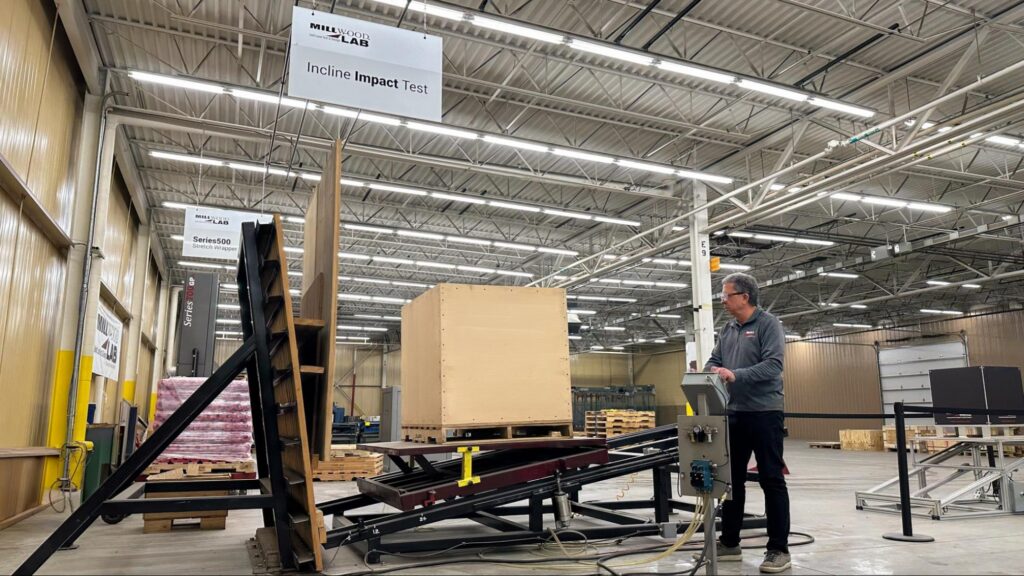
Jim Pepperney, Millwood’s Director of Sales for the Western Region and an authority on ASRS and unit load engineering, led the response effort. Millwood Packaging Science engineers redesigned, tested and validated three new pallet configurations on a tight deadline to keep the launch on schedule.
Haubert’s work represents pallet design and field engineering brought to bear on a six-month problem with no existing solution. Pepperney’s represents lab science and validation delivered under emergency pressure. Together, these stories reflect the full scope of what Millwood brings to ASRS: engineering the right pallet for the specific system, then proving it performs before it enters production.
What to Look for in an ASRS Pallet Partner
Choosing a pallet supplier for an ASRS environment is a fundamentally different decision than sourcing pallets for manual operations. The margin for error is too narrow and the cost of failure too high for a supplier that treats pallets as interchangeable commodities. When a single out-of-spec pallet can halt a system that moves thousands of loads per day, the supplier’s engineering capability matters as much as their price per unit.
An effective ASRS pallet partner demonstrates specific capabilities that general pallet suppliers often cannot:
- Engineering to millimeter tolerances. The supplier’s Team should design pallets to the exact dimensional requirements of the automated system, including metric specifications when the system demands them. Pallet Design System (PDS) software and direct engineering experience with ASRS configurations are baseline expectations.
- Testing and validation infrastructure. An ISTA-certified lab capable of running compression, deflection and racking load tests on the specific pallet design before it enters the system. Millwood operates one of only two fully accredited pallet testing labs owned by a pallet manufacturer in the nation.
- Documented ASRS field experience. Theoretical engineering capability is not the same as proven field experience. The right partner has designed, manufactured and supported ASRS pallet programs under real deadlines and real system constraints.
- Manufacturing consistency at scale. A pallet that meets ASRS tolerances on one unit must meet them across thousands or tens of thousands of units. Automated production systems and rigorous quality controls are not optional.
- A full unit load perspective. The right partner asks about racking specifications, conveyor type, load profile, stretch wrap parameters and storage density goals before recommending a pallet design. Millwood is the supplier that studies the complete system before quoting a solution.
Connect with a Millwood ASRS pallet specialist to evaluate whether your current pallets meet automation tolerances.
Explore Millwood’s block pallet solutions engineered for automated systems.